AI Ethics Every Small Business Should Know | Practical Guide for SMEs | Beritaja
AI Ethics Every Small Business Should Know
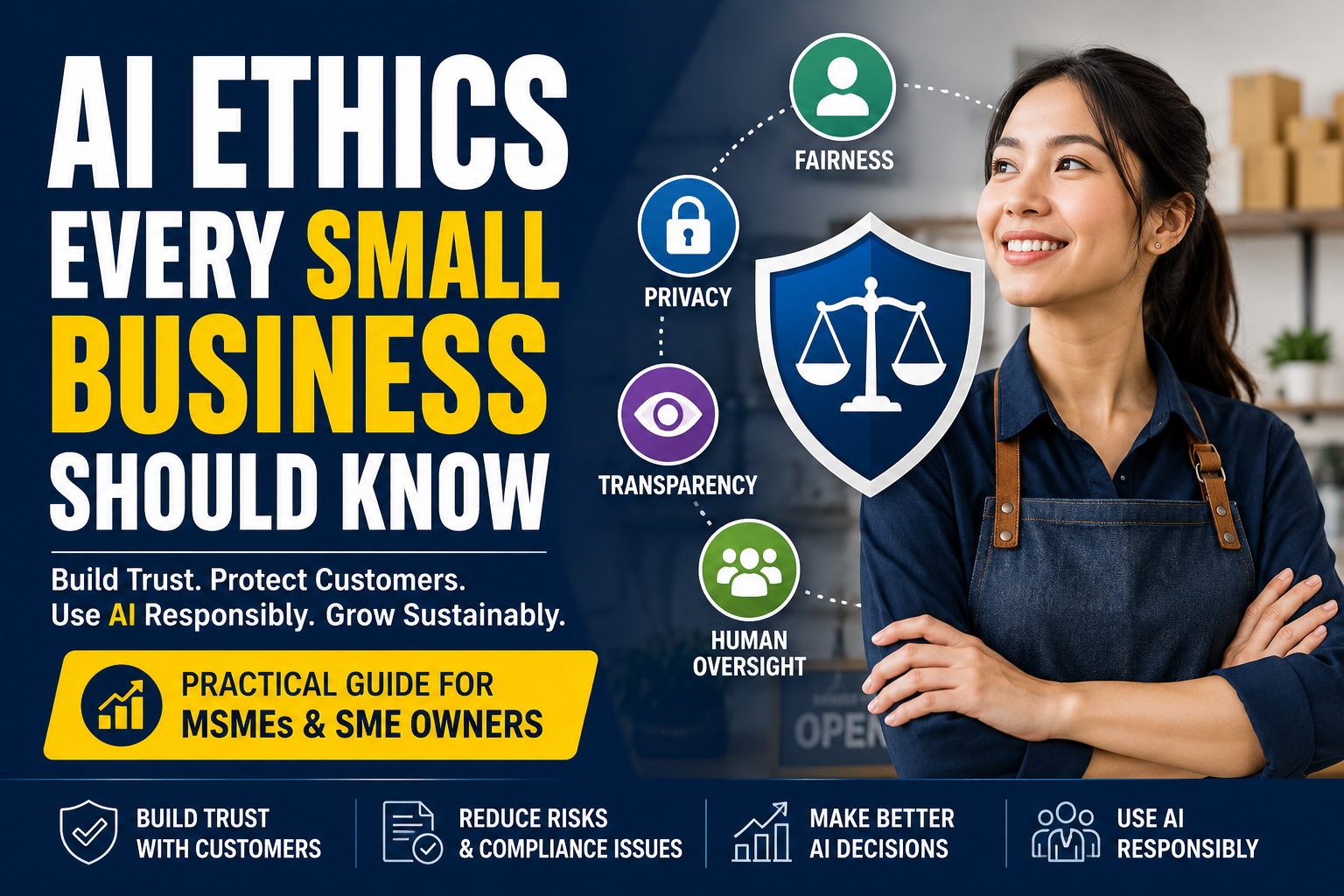
AI ethics is the practice of using artificial intelligence in ways that are fair, transparent, secure, privacy-conscious, accountable, and respectful of people. For a small business, AI ethics does not require a large compliance department or an expensive governance program. It means understanding how an AI system affects customers, employees, business decisions, and data—and putting reasonable safeguards in place before relying on it.
This matters because artificial intelligence is increasingly used for customer service, marketing, content creation, sales forecasting, data analysis, recruitment, workflow automation, and decision support. The same technology that saves time can also produce inaccurate information, expose sensitive data, reproduce bias, or encourage employees to rely on automated recommendations without sufficient review.
This guide explains the core principles of AI ethics for small businesses and shows how owners, managers, entrepreneurs, and non-technical teams can apply them without turning every AI project into a complicated technical exercise.
What Is AI Ethics?
AI ethics is a set of principles and practices for ensuring that artificial intelligence is developed, selected, deployed, and used responsibly. It focuses on questions such as whether an AI application treats people fairly, protects personal information, communicates its limitations, produces reliable results, and keeps humans accountable for important decisions.
For a small business, AI ethics is best understood as a practical decision-making discipline rather than an abstract technology topic. If a company uses an AI tool to write product descriptions, analyze customer messages, recommend prices, screen applications, or answer customer questions, the business should consider what could go wrong and who could be affected.
In simple terms: AI ethics asks whether your business is using AI in a way that is useful without creating unreasonable harm, unfairness, privacy problems, security risks, or misleading outcomes.
Ethical AI is closely related to responsible AI and AI governance. AI ethics focuses heavily on values and responsible behavior, while AI governance turns those principles into policies, roles, controls, documentation, and processes.
Businesses looking for the broader picture can also explore AI for MSMEs as the main topic hub and the complete guide to AI for small businesses for a wider introduction to artificial intelligence in business.
Why Does AI Ethics Matter for Small Businesses?
AI ethics matters because small businesses can experience many of the same risks as larger organizations even when their AI systems are relatively simple. A chatbot can give a customer incorrect information. A marketing system can make inappropriate assumptions about an audience. A generative AI application can receive confidential information that should never have been submitted to a third-party service.
Ethical AI also protects something that is particularly valuable to smaller companies: trust. Customers may forgive an occasional mistake, but repeated privacy problems, misleading automated communications, or unfair treatment can damage a company's reputation.
AI ethics helps businesses manage five practical concerns
- Customer trust: People need confidence that AI is not being used irresponsibly with their information.
- Decision quality: AI recommendations should be evaluated rather than automatically accepted.
- Privacy: Businesses should understand what information is being entered into AI systems and how it is handled.
- Fairness: Automated systems should not unnecessarily disadvantage customers, employees, applicants, or other groups.
- Accountability: A human or clearly defined business role should remain responsible for important outcomes.
AI adoption can provide meaningful business benefits, but responsible implementation should accompany those benefits. A useful starting point is to understand the benefits of AI for small business owners alongside the risks and trade-offs involved.
7 Core AI Ethics Principles Every Small Business Should Understand
There is no single universal checklist that fits every AI application. However, several principles consistently appear in responsible AI guidance and provide a practical foundation for small businesses.
1. Fairness and Non-Discrimination
AI systems should be used in ways that do not create unjustified or discriminatory outcomes. This is particularly important when AI influences decisions about people, such as hiring, customer eligibility, pricing, lending, access to services, or employee evaluation.
An AI system can appear neutral while still producing problematic results because its training data, design, assumptions, or implementation may reflect existing patterns or biases.
For example, a small company considering an AI recruitment system should not assume that an automated ranking is objective simply because a computer generated it. Human review remains important, especially when an AI recommendation could affect someone's employment opportunity.
2. Privacy and Responsible Data Use
Privacy is one of the most practical AI ethics issues for small businesses. Before entering information into an AI service, the business should know what type of data is being processed and whether the information is appropriate to share with that system.
Businesses should be particularly careful with information such as customer contact details, financial records, authentication credentials, confidential contracts, employee information, health-related information, and proprietary business data.
A simple rule is useful: Do not give an AI system sensitive information merely because the interface allows you to paste it.
Instead, determine whether the task can be completed using anonymized, generalized, synthetic, or otherwise non-sensitive information.
3. Transparency
Transparency means people should receive appropriate information about how AI is being used, particularly when the use could materially affect them.
Transparency does not necessarily mean revealing technical model architecture. For a small business, it may simply mean telling customers when they are interacting with an automated assistant, explaining that AI-generated content may require verification, or documenting how an AI-supported workflow operates.
Transparency is especially useful when an AI output could be questioned or challenged. People should not be left believing that an automated recommendation is an unquestionable human decision.
4. Accuracy and Reliability
AI systems can generate convincing but incorrect outputs. This is particularly relevant to generative AI and large language models (LLMs), which can produce fluent text without guaranteeing that every statement is factually correct.
Small businesses should therefore match the level of human review to the consequences of an error.
| AI Use | Potential Risk | Recommended Review |
| Drafting social media captions | Incorrect or inappropriate wording | Basic human review |
| Creating product descriptions | Incorrect specifications or claims | Review before publication |
| Customer support responses | Incorrect advice or policy information | Human escalation for sensitive issues |
| Financial analysis | Incorrect calculations or interpretation | Qualified human verification |
| Employment decisions | Potential unfair or discriminatory outcomes | Meaningful human decision-making |
5. Security and Safety
Ethical AI use also requires reasonable attention to security. AI tools can become another pathway through which confidential information is exposed or manipulated.
Businesses should consider account security, access controls, data sharing, vendor practices, authentication, employee permissions, and the possibility of malicious or unintended inputs.
For example, an employee should not automatically have permission to upload a company's entire customer database into an AI application simply because they use the application for marketing.
6. Accountability
Accountability means that responsibility does not disappear simply because AI was involved in a decision.
If an AI-generated response is sent to a customer, the business remains responsible for the communication. If an AI system provides a recommendation that influences an important decision, someone within the organization should understand who reviews and approves that recommendation.
A practical small-business rule is: AI can assist with a task, but responsibility should remain assigned to a person or clearly defined business role.
7. Human Oversight
Human oversight means people remain able to review, correct, override, or stop an AI-assisted process when appropriate.
The amount of oversight should depend on the potential impact of the task. A business may reasonably automate the first draft of a product description while requiring much stronger review for employment, financial, legal, safety, or customer eligibility decisions.
AI Ethics Examples for Small Businesses
The easiest way to understand AI ethics is to see how the principles apply to everyday business situations.
Example 1: Retail Business Using AI for Marketing
Business type: Retail
Problem: The business wants to produce marketing copy faster.
How AI is used: A generative AI tool creates initial product descriptions and promotional ideas.
Expected benefit: Employees can spend less time producing first drafts and more time reviewing and refining campaigns.
Human oversight required: Staff should verify product specifications, pricing, promotions, claims, and tone before publication.
Example 2: Restaurant Using an AI Customer Assistant
Business type: Restaurant
Problem: Customers repeatedly ask about menus, opening hours, reservations, and basic policies.
How AI is used: An AI assistant handles routine questions.
Expected benefit: Staff can spend more time serving customers while the assistant handles common informational requests.
Human oversight required: The system should provide a clear path to a human for unusual requests, complaints, allergies, refunds, or other sensitive situations.
Example 3: Professional Services Firm Using AI for Documents
Business type: Professional services
Problem: Employees spend significant time summarizing documents and preparing drafts.
How AI is used: AI produces preliminary summaries and document drafts.
Expected benefit: Staff can accelerate routine preparation work.
Human oversight required: Confidential information should be handled according to company policy, and final documents should be reviewed by an appropriately qualified person.
Example 4: E-Commerce Business Using AI Recommendations
Business type: E-commerce
Problem: The company wants to recommend relevant products to customers.
How AI is used: An AI or machine-learning system analyzes product and interaction data to generate recommendations.
Expected benefit: Customers may find relevant products more easily.
Human oversight required: The company should monitor recommendation quality, privacy practices, unexpected patterns, and potentially unfair outcomes.
AI Ethics vs. AI Governance: What Is the Difference?
AI ethics describes the values and principles that should guide responsible AI use, while AI governance provides the organizational structure for putting those principles into practice.
| AI Ethics | AI Governance |
| Focuses on responsible values | Focuses on policies and processes |
| Asks whether an AI use is fair and appropriate | Defines who approves and monitors AI use |
| Considers privacy, fairness, transparency and human impact | Creates controls, documentation and accountability |
| Guides behavior | Operationalizes responsible behavior |
These ideas work together. A small business does not necessarily need a large formal governance department, but it can benefit from simple rules about approved AI tools, sensitive information, human review, accountability, and incident reporting.
For a deeper discussion of organizational controls, see AI governance strategy for small businesses.
How to Implement AI Ethics in a Small Business
Small businesses can begin with a lightweight AI ethics process. The goal is not to create bureaucracy. The goal is to identify meaningful risks before AI becomes embedded in everyday operations.
Step 1 — List Your Current AI Uses
Start by identifying where AI is already being used. Include formal company systems as well as tools employees may be using independently.
Examples include:
- Generative AI for writing
- AI customer service tools
- AI-powered marketing platforms
- Machine-learning forecasting
- AI productivity assistants
- Automated document processing
- AI-powered analytics
Understanding the current situation is important because businesses often have more AI exposure than they initially realize.
Step 2 — Classify the Business Impact
Not every AI use deserves the same level of control. Classify each use according to its potential impact.
- Low impact: brainstorming, formatting, drafting internal notes.
- Moderate impact: customer communications, marketing recommendations, forecasting.
- High impact: employment decisions, financial decisions, eligibility decisions, safety-sensitive activities, or decisions that significantly affect individuals.
Step 3 — Define What Data Can Be Used
Create a simple data policy. Employees should know what information can be entered into AI tools and what information requires additional approval or must not be submitted.
For example, a business could prohibit employees from entering passwords, payment credentials, confidential contracts, unnecessary personal information, or proprietary customer records into unapproved AI systems.
Step 4 — Establish Human Review Rules
Decide which AI outputs require review before they are used.
A useful rule is to increase human oversight as the potential impact of an error increases. Routine marketing drafts may need a quick review, while decisions involving employment, finance, legal matters, safety, or significant customer consequences require much more careful human involvement.
Step 5 — Test Before Scaling
Start with a limited workflow rather than introducing AI across the entire organization at once.
Test whether the system produces useful results, where it fails, what information it requires, how employees interact with it, and whether the expected benefit justifies the cost and risk.
Step 6 — Document Important Decisions
Keep simple records for higher-impact AI applications. Documentation can include the purpose of the system, data sources, responsible employee, approval process, known limitations, review requirements, and steps to take when something goes wrong.
Step 7 — Review the System Regularly
AI systems, vendors, workflows, and business requirements can change. An AI process that was appropriate six months ago may require modification after the business changes its data, customers, employees, or use case.
Responsible AI should therefore be treated as an ongoing management process rather than a one-time approval.
A Simple AI Ethics Framework for SMEs
A small business can turn the principles above into a practical seven-question review before adopting an AI application.
- Purpose: What business problem are we trying to solve?
- People: Who could be affected by the AI system?
- Data: What information does the system require?
- Accuracy: What happens if the AI is wrong?
- Fairness: Could the system produce unjustified disadvantages for certain people?
- Control: Who reviews, approves, corrects, or stops the AI-assisted process?
- Accountability: Who is responsible for the final outcome?
If the answers are unclear, the business should pause before scaling the AI use. Uncertainty does not automatically mean that AI should not be used, but it is a reason to investigate the workflow more carefully.
Common AI Ethics Risks Small Businesses Should Avoid
Responsible AI is easier when businesses understand the most common failure modes. Several risks deserve particular attention.
1. Treating AI Outputs as Facts
AI-generated text can sound confident even when it is inaccurate. Employees should verify important claims rather than assuming fluent output is reliable.
2. Uploading Sensitive Business Information
Convenience can encourage employees to paste confidential material into AI systems without considering privacy, contractual, security, or vendor implications.
3. Automating High-Impact Decisions Too Quickly
Automation can be useful, but some decisions have consequences that make human review essential. Businesses should be particularly cautious when AI influences employment, financial, legal, safety, or access-related decisions.
4. Assuming AI Is Automatically Unbiased
AI systems learn from data and operate within the constraints of their design. Businesses should not assume that an automated output is inherently fair simply because a human did not manually produce it.
5. Ignoring Vendor Risk
A business may not build its own AI model, but it is still responsible for understanding how an AI-enabled vendor fits into its operations. Important questions include what data is processed, what controls are available, what permissions are required, and what happens if the service changes or becomes unavailable.
6. Eliminating Human Expertise
AI should not automatically replace the people who understand the business, its customers, and its operational context. In many workflows, AI is most useful as a decision-support or productivity tool rather than an independent authority.
These risks overlap with broader AI adoption challenges. Businesses can also review the biggest barriers to AI adoption for small businesses before designing an implementation plan.
When Should a Small Business Not Use AI?
AI is not automatically the best solution simply because it is available. A traditional workflow may be preferable when the task is simple, inexpensive, highly sensitive, or already handled effectively by a human.
A business should reconsider AI when the system introduces more complexity than value, requires sensitive data that cannot be safely handled, produces unreliable results, or creates risks that cannot be adequately controlled.
For example, if an employee can complete a simple calculation accurately in seconds using an existing spreadsheet, adding an AI system may provide little benefit. Similarly, automating a high-consequence decision may be inappropriate if the business cannot adequately validate the system's behavior.
The right question is not: "Where can we use AI?"
A better question is: "Where can AI create meaningful value while the business can reasonably manage the risks?"
How AI Ethics Applies to Generative AI and AI Automation
Generative AI creates new ethical considerations because it can produce text, images, code, summaries, recommendations, and other content at high speed. Businesses therefore need to think about accuracy, disclosure, privacy, intellectual property, security, and human review.
Small businesses exploring this area can first understand what generative AI is and why it matters to small businesses.
AI automation introduces another consideration: the more steps a system performs without human intervention, the more important it becomes to define boundaries, exceptions, monitoring, and escalation procedures.
Businesses considering automation should therefore understand AI automation for small businesses before turning an experimental workflow into a production process.
Similarly, AI can support productivity, decision-making, and business intelligence, but each use case requires its own level of review. Related guides on AI productivity, AI decision making, and AI business intelligence provide useful context for these applications.
AI Ethics Checklist for Small Business Owners
Before approving a new AI workflow, use this short checklist:
- What specific business problem does the AI solve?
- Who could be affected by the system?
- What data does the system receive?
- Does the data contain confidential or personal information?
- What happens if the AI produces an incorrect result?
- Could the system produce unfair or discriminatory outcomes?
- Does the customer or employee need to know that AI is involved?
- Who reviews important outputs?
- Who can override or stop the process?
- Who is accountable for the final decision?
- How will the business monitor the system after deployment?
- When should the AI workflow be reviewed or retired?
This checklist is intentionally simple. The objective is to make responsible thinking part of normal business decisions rather than creating an administrative burden that discourages useful AI adoption.
Related AI Guides for Small Businesses
AI ethics is only one part of responsible AI adoption. Business owners can build a stronger understanding of the topic by connecting ethics with AI fundamentals, technology selection, adoption strategy, and future planning.
- Artificial intelligence for small businesses: a beginner's guide
- Top AI trends every MSME should watch
- AI myths every business owner should stop believing
- The future of AI for small businesses
- What is AI software?
- Machine learning explained for small business owners
- What are large language models (LLMs)?
Frequently Asked Questions About AI Ethics
What is AI ethics in simple terms?
AI ethics means using artificial intelligence responsibly and considering how AI affects people, data, decisions, and society. For a small business, this usually means paying attention to fairness, privacy, transparency, accuracy, security, accountability, and human oversight. The goal is not to avoid AI but to use it in ways that create useful business value without introducing unreasonable risks.
Why is AI ethics important for small businesses?
AI ethics is important because small businesses can use AI in customer service, marketing, hiring, analytics, automation, and decision support. Errors or irresponsible use in these areas can affect customers, employees, business reputation, and confidential information. A practical ethics process helps owners identify risks before an AI workflow becomes difficult to change.
What are the main principles of AI ethics?
Common principles include fairness, privacy, transparency, accountability, security, reliability, safety, and human oversight. Different frameworks may organize these ideas differently, but the underlying goal is similar: AI should be used responsibly, its limitations should be understood, and people should remain appropriately involved in important decisions.
Should small businesses avoid using AI for important decisions?
Not necessarily, but high-impact decisions require more caution than low-risk tasks. If AI influences employment, financial matters, eligibility, safety, or other consequential outcomes, the business should use stronger validation, documentation, and human oversight. AI should generally support informed decision-making rather than becoming an unquestioned authority.
How can a small business protect customer privacy when using AI?
Start by identifying what information an AI tool receives and whether that information is necessary. Avoid submitting sensitive or confidential information to unapproved systems. Establish clear employee rules for data handling, use appropriate access controls, and understand the relevant privacy obligations and vendor practices before deploying AI in customer-facing workflows.
Can AI be ethical if it makes mistakes?
Ethical AI does not mean an AI system will never make a mistake. Instead, responsible use requires understanding the system's limitations and designing controls around them. Businesses should determine how serious an error could be, add appropriate human review, provide ways to correct mistakes, and avoid relying on AI beyond what the system can reasonably support.
Does AI ethics require a large governance team?
No. A small business can begin with simple responsibilities and policies. For example, the company can identify approved AI tools, define prohibited data, assign owners to higher-risk AI workflows, establish human-review requirements, and periodically review performance. More formal governance may become appropriate as AI use expands or becomes more consequential.
Conclusion: Make AI Ethics Part of Responsible Business Growth
AI ethics is about making responsible choices when using artificial intelligence. For small businesses, that means thinking beyond productivity and asking whether an AI workflow is fair, accurate, secure, privacy-conscious, transparent, and appropriately supervised.
The most practical approach is to start small. Identify where AI is being used, classify the potential impact, protect sensitive information, define human-review requirements, document important decisions, and monitor the results.
Businesses do not need to eliminate AI because risks exist. They also should not adopt AI blindly because the technology is popular. The better approach is to connect AI adoption with clear business objectives, sensible safeguards, and accountable human judgment.
As AI becomes more deeply integrated into marketing, operations, customer service, analytics, and decision support, AI ethics can become part of the foundation for sustainable and trustworthy AI adoption.