Challenges of AI Adoption for Small Businesses: 12 Biggest Barriers & Solutions (2026)


Challenges of AI Adoption for Small Businesses: The Complete 2026 Guide
Artificial intelligence has become one of the most transformative technologies for businesses worldwide. From customer service automation and marketing optimization to inventory forecasting and financial analysis, AI offers opportunities that were once available only to large enterprises.
Yet despite the excitement surrounding AI, many entrepreneurs struggle to move from curiosity to successful implementation. Surveys consistently show that while business owners recognize AI's potential, a significant percentage fail to integrate it effectively into their daily operations.
The reality is simple: adopting AI isn't just about purchasing software. It requires thoughtful planning, organizational readiness, employee engagement, quality data, and continuous improvement.
For small businesses, these obstacles can feel even more significant due to limited budgets, smaller teams, and fewer technical resources. However, understanding these challenges is the first step toward overcoming them.
If you're still exploring AI fundamentals, start with our comprehensive guide, What Is AI for MSMEs? The Complete Guide (2026), which explains how artificial intelligence works and why it matters for modern businesses.
You may also benefit from reading What Is Artificial Intelligence for Small Businesses?, where we explain AI concepts in simple language for beginners.
In this guide, we'll explore the most common challenges of AI adoption for small businesses, explain why they occur, and provide practical solutions that can help organizations implement AI successfully in 2026 and beyond.
Why AI Adoption Is Still Difficult for Small Businesses
Although AI tools have become significantly more affordable over the past few years, successful implementation involves much more than paying a monthly subscription fee.
Many companies underestimate the organizational changes required when introducing AI into existing workflows. Employees need training, business processes often require redesign, and managers must learn how to interpret AI-generated recommendations rather than relying solely on intuition.
Small businesses also tend to prioritize short-term operational needs over long-term digital transformation. Daily responsibilities such as customer service, inventory management, payroll, and sales often leave little time to experiment with new technologies.
Additionally, the AI marketplace evolves rapidly. Hundreds of new AI tools appear every month, making it difficult for business owners to distinguish genuinely valuable solutions from marketing hype.
Without a clear implementation strategy, many organizations invest in AI software that ultimately goes unused.
The Business Cost of Ignoring AI Challenges
Ignoring AI implementation challenges can be expensive.
Businesses that adopt AI without preparation often experience poor employee adoption, inaccurate results, wasted software subscriptions, security concerns, and disappointing returns on investment.
On the other hand, organizations that recognize these obstacles early can create realistic implementation plans, minimize risks, and maximize long-term value.
Instead of viewing AI as a quick technological upgrade, successful businesses treat AI adoption as an ongoing business transformation.
This mindset significantly improves the chances of sustainable success.
The 12 Biggest Challenges of AI Adoption for Small Businesses
While every business is unique, most organizations encounter similar obstacles during their AI journey.
Let's examine each challenge in detail.
1. Limited Budget and Investment Concerns
Budget remains one of the biggest barriers preventing small businesses from adopting AI.
Although many AI applications now offer affordable subscription pricing, implementation costs often extend beyond software licenses.
Business owners must consider:
- Employee training
- Workflow redesign
- Software integration
- Consulting expenses
- Data preparation
- Ongoing maintenance
For startups and small enterprises operating on tight margins, these expenses can appear overwhelming.
Why This Happens
Many entrepreneurs mistakenly assume AI requires enterprise-level investments similar to those made by multinational corporations.
While custom AI development can indeed be expensive, many modern AI platforms operate using scalable subscription models that allow businesses to start small.
How to Overcome It
- Start with one AI use case.
- Measure ROI before expanding.
- Use cloud-based AI services.
- Choose no-code AI platforms.
- Avoid purchasing multiple tools simultaneously.
Rather than trying to automate every department at once, begin with a single process that delivers measurable value.
2. Lack of AI Knowledge
One of the most underestimated challenges is limited understanding of artificial intelligence.
Many business owners believe AI requires advanced programming skills or a team of data scientists.
This misconception discourages adoption before implementation even begins.
In reality, today's AI tools are increasingly designed for non-technical users.
Common Misconceptions
- AI replaces every employee.
- AI works without human supervision.
- AI instantly solves business problems.
- AI always generates perfect results.
- Only technology companies benefit from AI.
These myths often create unnecessary fear and hesitation.
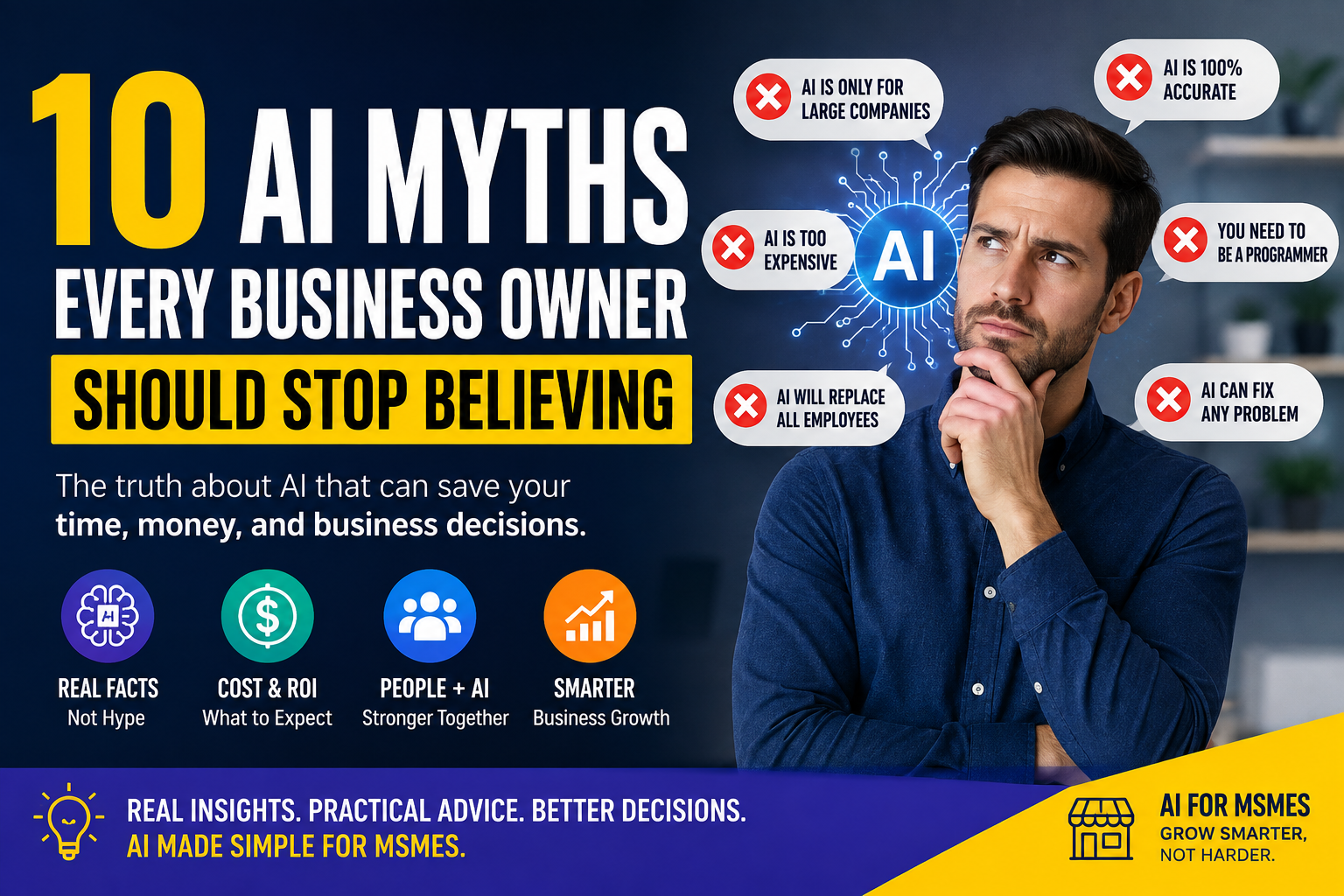
For a deeper understanding, read our article 10 AI Myths Every Business Owner Should Stop Believing.
Recommended Solution
- Provide AI literacy training.
- Encourage experimentation.
- Attend webinars.
- Take free online AI courses.
- Start with beginner-friendly applications.
3. Poor Data Quality
Artificial intelligence depends on data.
If the information entering an AI system is incomplete, outdated, inconsistent, or inaccurate, the resulting recommendations will also be unreliable.
This concept is commonly summarized as Garbage In, Garbage Out (GIGO).
Many small businesses store customer information across multiple spreadsheets, outdated software systems, handwritten notes, or disconnected databases.
Without clean and organized data, AI cannot produce meaningful insights.
Examples of Poor Business Data
- Duplicate customer records
- Missing sales historyInconsistent product names
- Outdated supplier information
- Incorrect inventory counts
- Incomplete customer profiles
Best Practices
- Clean databases regularly.
- Standardize naming conventions.
- Remove duplicate records.
- Centralize customer information.
- Establish data governance policies.
Improving data quality often produces immediate business benefits even before AI implementation begins.
4. Employee Resistance to Change
Technology adoption isn't just a technical challenge—it is also a human challenge.
Employees may worry that AI will replace their jobs, reduce their responsibilities, or make their experience less valuable.
Without proper communication, these concerns can slow adoption and reduce productivity.
Managers should explain that AI is designed to assist employees rather than replace them in most small business environments.
Common Employee Concerns
- Fear of job loss
- Learning new technology
- Reduced decision-making authority
- Increased monitoring
- Changes to established workflows
How Successful Companies Respond
- Provide transparent communication.
- Offer hands-on training.
- Celebrate early successes.
- Include employees in planning.
- Gather regular feedback.
Organizations that involve employees throughout implementation typically experience higher adoption rates and better long-term outcomes.
5. Choosing the Wrong AI Tool
The AI software market is expanding at an unprecedented pace.
Every week, new platforms promise to automate marketing, accounting, customer support, sales, recruitment, content creation, analytics, and countless other business functions.
While this abundance creates opportunities, it also introduces confusion.
Many small business owners purchase AI software based solely on advertising claims rather than business needs.
As a result, they end up paying for features they rarely use while overlooking solutions that better match their operational challenges.
Warning Signs
- Buying AI before defining the problem
- Selecting software because competitors use it
- Ignoring integration capabilities
- Choosing overly complex platforms
- Failing to calculate expected ROI
Best Practice
Always identify your business objective first.
Then evaluate AI tools based on measurable outcomes, ease of implementation, scalability, security, customer support, and compatibility with your existing systems.
If you're still deciding whether AI is worth implementing, you may also enjoy reading Top Benefits of AI for Small Business Owners, which explains where AI delivers the highest return on investment.
6. Integration with Existing Business Systems
One of the most overlooked challenges of AI adoption for small businesses is integrating new AI tools with existing software. Many businesses already rely on accounting platforms, CRM systems, eCommerce solutions, inventory management software, and communication tools.
If your AI solution cannot communicate effectively with these existing systems, employees may end up manually transferring data between applications, reducing efficiency instead of improving it.
Integration issues can also create data inconsistencies, duplicated records, and reporting errors.
Common Integration Challenges
- Legacy software without API support
- Different data formats between systems
- Duplicate customer databases
- Disconnected sales and inventory platforms
- Manual data synchronization
How to Solve Integration Problems
- Choose AI platforms with API support.
- Prioritize cloud-based software.
- Centralize business data whenever possible.
- Test integrations before full deployment.
- Document every workflow change.
Successful AI implementation depends on seamless data flow. The less manual work required, the greater the long-term return on investment.
7. Data Privacy and Cybersecurity Risks
AI systems often process large volumes of customer, employee, and financial information. Protecting this data has become increasingly important as privacy regulations continue to evolve worldwide.
Small businesses sometimes assume cybercriminals only target large corporations. In reality, smaller organizations are frequently targeted because they often have fewer security resources.
Uploading confidential information into AI tools without understanding how that data is stored or processed can introduce unnecessary risks.
Potential Security Risks
- Unauthorized data access
- Weak passwords and authentication
- Sharing confidential business information with public AI tools
- Insufficient employee cybersecurity awareness
- Third-party vendor vulnerabilities
Best Practices for AI Security
- Enable multi-factor authentication (MFA).
- Use trusted AI providers.
- Review privacy policies carefully.
- Limit access to sensitive information.
- Train employees on cybersecurity awareness.
- Regularly back up critical business data.
Security should be considered from the beginning of every AI project rather than added later as an afterthought.
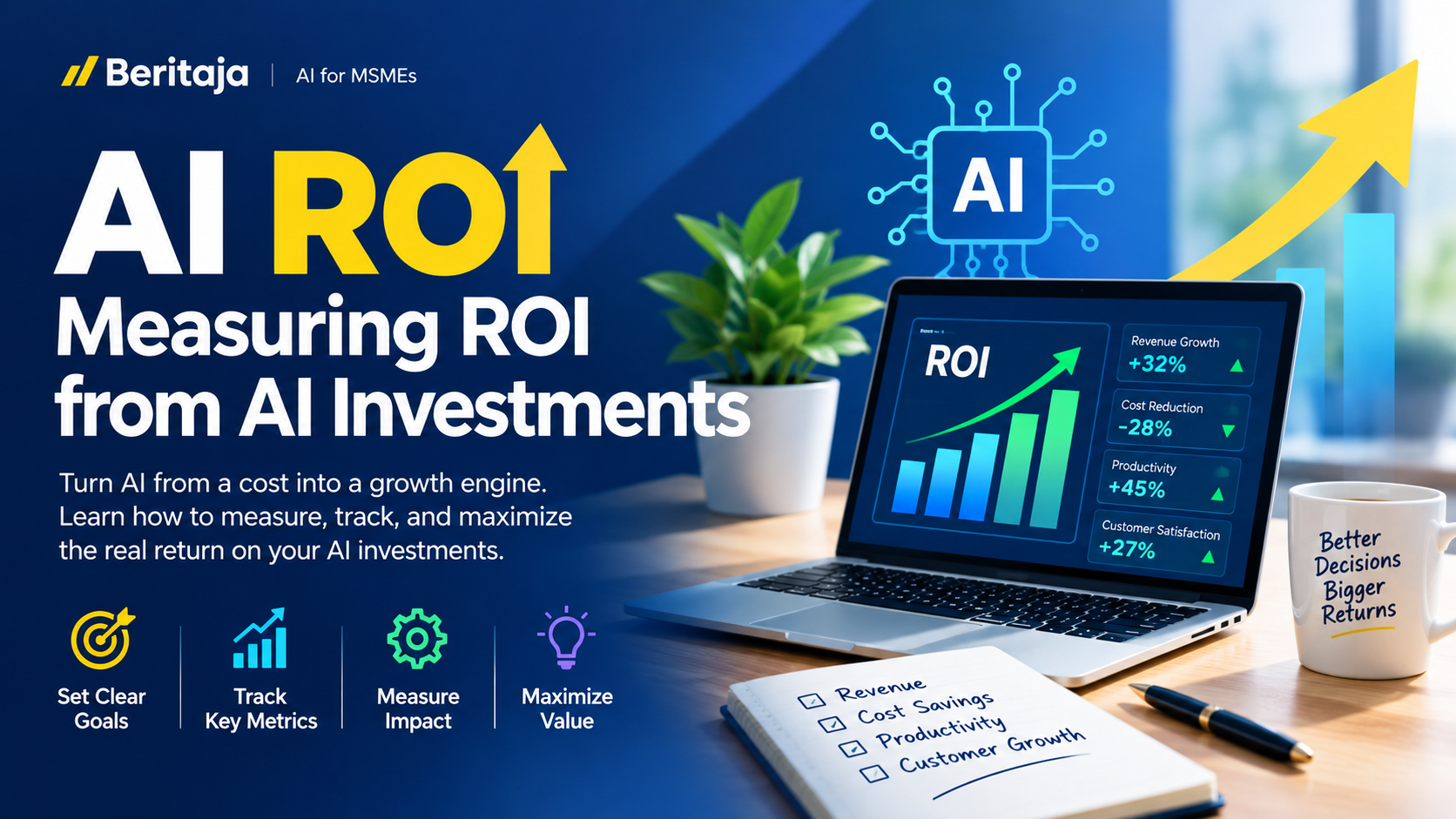
8. Difficulty Measuring Return on Investment (ROI)
Business owners naturally want to know whether AI is generating measurable value. However, calculating AI's return on investment is not always straightforward.
Some benefits, such as faster customer support or improved employee productivity, may not immediately appear in financial reports.
Without clear performance metrics, businesses may underestimate AI's impact or abandon promising initiatives too early.
Useful AI KPIs
- Customer response time
- Lead conversion rate
- Sales growth
- Cost savings
- Employee productivity
- Error reduction
- Customer satisfaction
- Time saved through automation
ROI Best Practice
Define measurable success indicators before implementing AI. Compare performance before and after adoption using the same evaluation criteria.
9. Unrealistic Expectations
Artificial intelligence is powerful, but it is not magic.
Some organizations expect AI to immediately double sales, eliminate operational costs, or replace entire departments. These unrealistic expectations often lead to disappointment.
AI performs best when solving clearly defined problems. Businesses that begin with achievable objectives typically achieve greater long-term success than those expecting instant transformation.
Examples of Unrealistic Expectations
- Expecting AI to run the business independently
- Believing AI never makes mistakes
- Assuming implementation requires no training
- Expecting immediate profits
- Replacing human judgment entirely
Recommended Mindset
Treat AI as a decision-support tool that enhances human expertise rather than replacing it.
10. Limited Internal Technical Expertise
Many small businesses do not employ dedicated IT departments or AI specialists.
This lack of technical expertise can make software evaluation, implementation, troubleshooting, and optimization more challenging.
Fortunately, today's AI ecosystem increasingly offers user-friendly platforms requiring little or no programming knowledge.
How Small Businesses Can Adapt
- Use no-code AI platforms.
- Partner with experienced consultants.
- Train existing employees.
- Leverage vendor onboarding resources.
- Join AI business communities.
Building internal AI knowledge gradually is often more sustainable than hiring expensive specialists immediately.
11. Keeping Up with Rapid AI Innovation
The AI landscape changes at an extraordinary pace. New language models, automation platforms, productivity tools, and industry-specific AI applications emerge almost every month.
Business owners often struggle to determine whether they should adopt new technologies immediately or wait until they become more mature.
Attempting to adopt every new AI trend can become both expensive and distracting.
How to Stay Competitive
- Review your AI strategy quarterly.
- Focus on business outcomes instead of trends.
- Monitor trusted technology publications.
- Experiment with one innovation at a time.
- Regularly evaluate software performance.
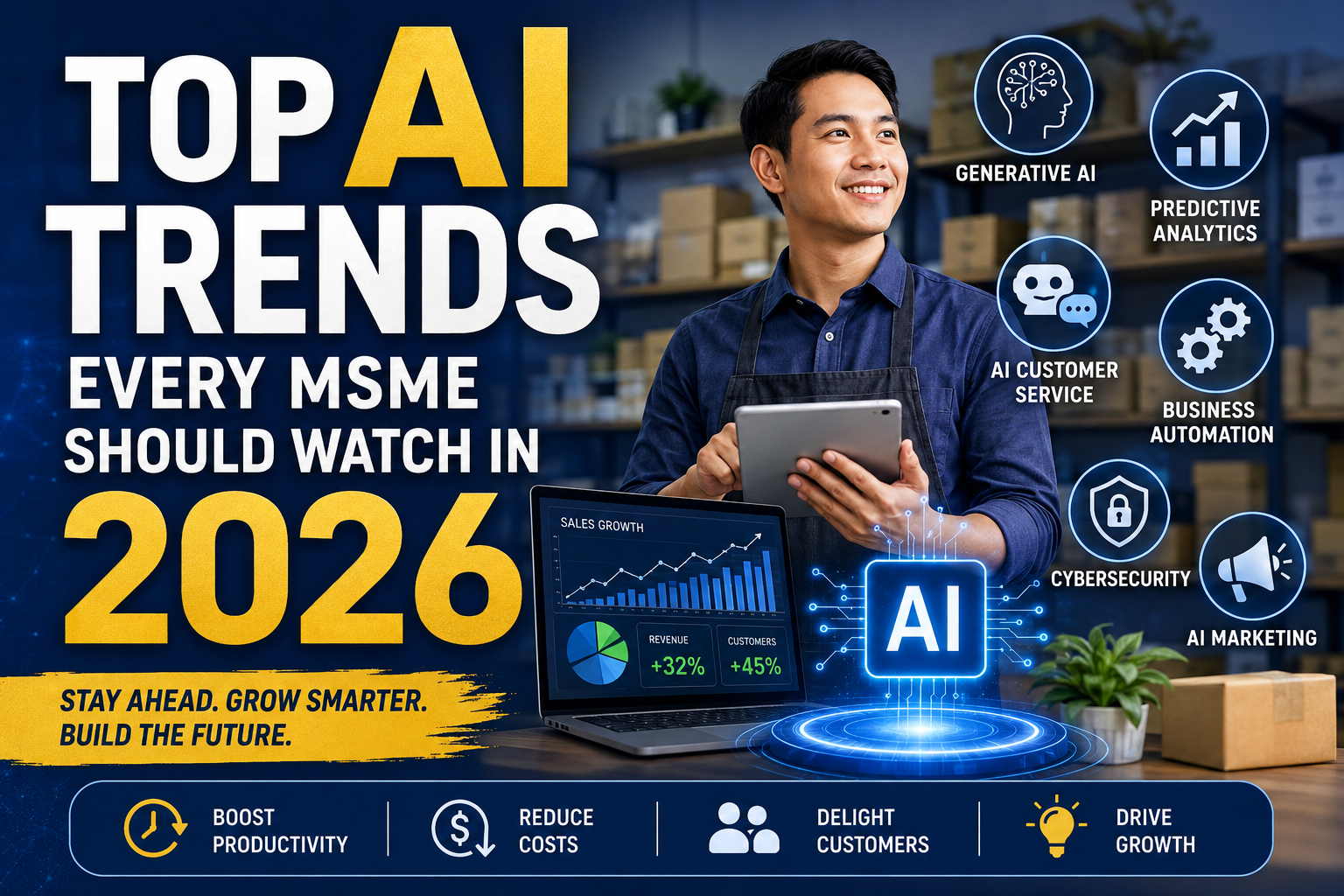
To understand where AI is heading, read our related guide: Top AI Trends Every MSME Should Watch in 2026.
12. Ethical and Responsible AI Use
As AI becomes more capable, businesses must also consider ethical responsibilities. Customers increasingly expect organizations to use AI transparently, fairly, and responsibly.
Bias in AI-generated recommendations, inaccurate content, or a lack of transparency can damage customer trust.
Responsible AI governance helps businesses build stronger relationships with employees and customers alike.
Ethical AI Principles
- Transparency
- Human oversight
- Data privacy
- Fairness
- Accountability
- Continuous monitoring
AI should always support human decision-making rather than replacing ethical responsibility.
Real-World Examples of AI Adoption Challenges
Example 1: Retail Business
A local retail company implemented an AI inventory forecasting system without cleaning its historical sales data. Because product records contained duplicates and outdated inventory counts, AI recommendations were inaccurate. After standardizing the data, forecast accuracy improved significantly.
Example 2: Marketing Agency
A small marketing agency adopted AI writing assistants expecting fully publishable content. Instead, the team learned that AI-generated drafts required human editing, fact-checking, and brand customization. Productivity increased, but only after establishing a structured editorial workflow.
Example 3: Customer Support
An online retailer launched an AI chatbot without training employees. Customer questions that required human judgment were not handled efficiently. After introducing escalation procedures and employee training, customer satisfaction scores improved substantially.
Risk vs Opportunity Comparison
| Challenge | Potential Risk | Recommended Solution |
| Limited Budget | Delayed implementation | Start with one AI project |
| Poor Data | Inaccurate AI outputs | Improve data quality |
| Employee Resistance | Low adoption rates | Provide training and communication |
| Security Risks | Data breaches | Strengthen cybersecurity practices |
| Wrong AI Tool | Low ROI | Select tools based on business goals |
| Integration Issues | Workflow inefficiencies | Choose compatible platforms |
How to Build a Successful AI Adoption Strategy
Organizations that succeed with AI rarely deploy everything at once. Instead, they follow a structured roadmap that minimizes risk while maximizing learning.
- Identify one high-impact business problem.
- Collect and organize reliable data.
- Select an AI solution aligned with your objectives.
- Train employees before deployment.
- Launch a small pilot project.
- Measure key performance indicators.
- Gather employee and customer feedback.
- Improve workflows continuously.
- Expand implementation gradually across departments.
This phased approach helps reduce implementation costs while increasing employee confidence and long-term success.
Best Practices for Small Businesses Adopting AI in 2026
- Focus on solving real business problems rather than chasing trends.
- Start with affordable, cloud-based AI solutions.
- Maintain clean and organized business data.
- Invest in employee education.
- Review cybersecurity policies regularly.
- Measure business outcomes consistently.
- Continuously improve AI workflows.
- Keep humans involved in important decisions.
Businesses that combine technology with strong leadership and continuous learning are far more likely to achieve sustainable AI success.
The Future of AI Adoption for Small Businesses
Artificial intelligence is rapidly evolving from an optional business tool into a competitive necessity. In 2026 and beyond, AI will become more accessible, affordable, and easier to integrate into everyday business operations.
Cloud computing, no-code automation platforms, multimodal AI models, and industry-specific AI assistants are lowering the barriers to adoption. Small businesses no longer need large development teams or enterprise-sized budgets to benefit from intelligent technologies.
Instead of replacing employees, AI is increasingly serving as a collaborative assistant that helps teams make faster decisions, automate repetitive work, personalize customer experiences, and uncover insights hidden within business data.
Companies that begin experimenting with AI today will be better positioned to adapt as technology continues to advance. The key is not adopting every new AI tool but building a sustainable strategy focused on measurable business outcomes.
To understand where the technology is heading next, continue with our guide: The Future of AI for Small Businesses.
Final Thoughts
The challenges of AI adoption for small businesses are real, but they are far from impossible to overcome.
Budget limitations, employee resistance, data quality issues, cybersecurity concerns, and integration difficulties often discourage organizations from moving forward. However, these obstacles can be addressed through careful planning, realistic expectations, continuous learning, and a phased implementation strategy.
The most successful businesses rarely attempt to transform everything overnight. Instead, they begin with one meaningful use case, measure results, refine their processes, and gradually expand AI across their operations.
Remember that AI is not a replacement for human expertise—it is a powerful tool that amplifies creativity, productivity, and informed decision-making.
If you're just beginning your AI journey, we recommend reading these related resources to build a complete understanding of AI for MSMEs:
- What Is AI for MSMEs? The Complete Guide (2026)
- What Is Artificial Intelligence for Small Businesses?
- Top Benefits of AI for Small Business Owners
- Top AI Trends Every MSME Should Watch in 2026
- 10 AI Myths Every Business Owner Should Stop Believing
- The Future of AI for Small Businesses
Together, these articles form a comprehensive learning path designed to help entrepreneurs confidently adopt AI while avoiding common implementation mistakes.
Frequently Asked Questions (FAQ)
What is the biggest challenge of AI adoption for small businesses?
The biggest challenge is usually a combination of limited budgets, insufficient AI knowledge, poor data quality, and employee resistance. Rather than focusing on technology alone, successful businesses prepare their people, processes, and data before implementing AI.
Is AI too expensive for small businesses?
No. Many modern AI platforms offer affordable subscription pricing and free entry-level plans. Small businesses can begin with a single use case and expand gradually as they realize measurable returns on investment.
Do small businesses need AI experts?
Not necessarily. Many AI tools are designed for non-technical users and require little or no programming experience. Business owners can also benefit from online training, vendor support, and no-code AI platforms.
Can AI replace employees?
In most cases, AI is intended to augment rather than replace employees. It automates repetitive tasks, allowing people to focus on strategic thinking, creativity, customer relationships, and decision-making.
How can businesses reduce AI implementation risks?
Businesses can reduce risk by defining clear objectives, cleaning their data, training employees, choosing trusted AI providers, strengthening cybersecurity, launching small pilot projects, and measuring results before scaling.
What industries benefit the most from AI?
Nearly every industry can benefit, including retail, healthcare, manufacturing, finance, education, hospitality, logistics, professional services, and eCommerce. The best results come from solving specific business problems rather than adopting AI simply because it is popular.
How long does AI implementation take?
Simple AI tools such as chatbots, writing assistants, or customer support automation can often be implemented within days or weeks. More complex AI initiatives involving multiple systems, data integration, and workflow redesign may take several months.
What should businesses do before adopting AI?
Before implementing AI, businesses should identify their goals, evaluate current workflows, improve data quality, educate employees, define success metrics, and select AI solutions that align with their operational needs.