What Is AI Software? A Beginner's Guide for SMEs

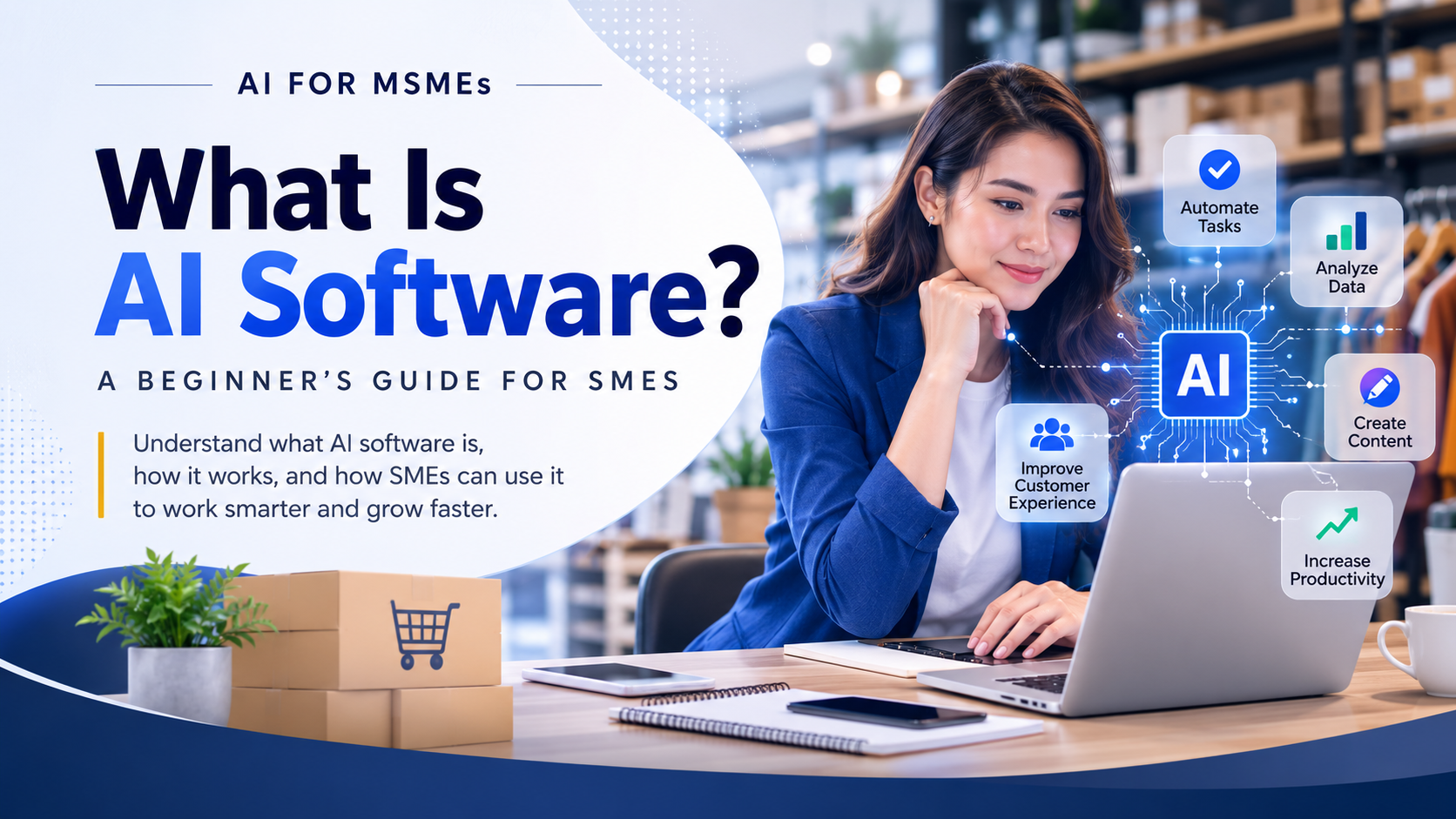
What Is AI Software? A Beginner's Guide for SMEs
A
rtificial intelligence (AI) is no longer limited to large technology companies with massive budgets and dedicated research teams. Today, small and medium-sized enterprises (SMEs) can use AI software to automate repetitive work, analyze information, improve customer experiences, create content, and support better business decisions.
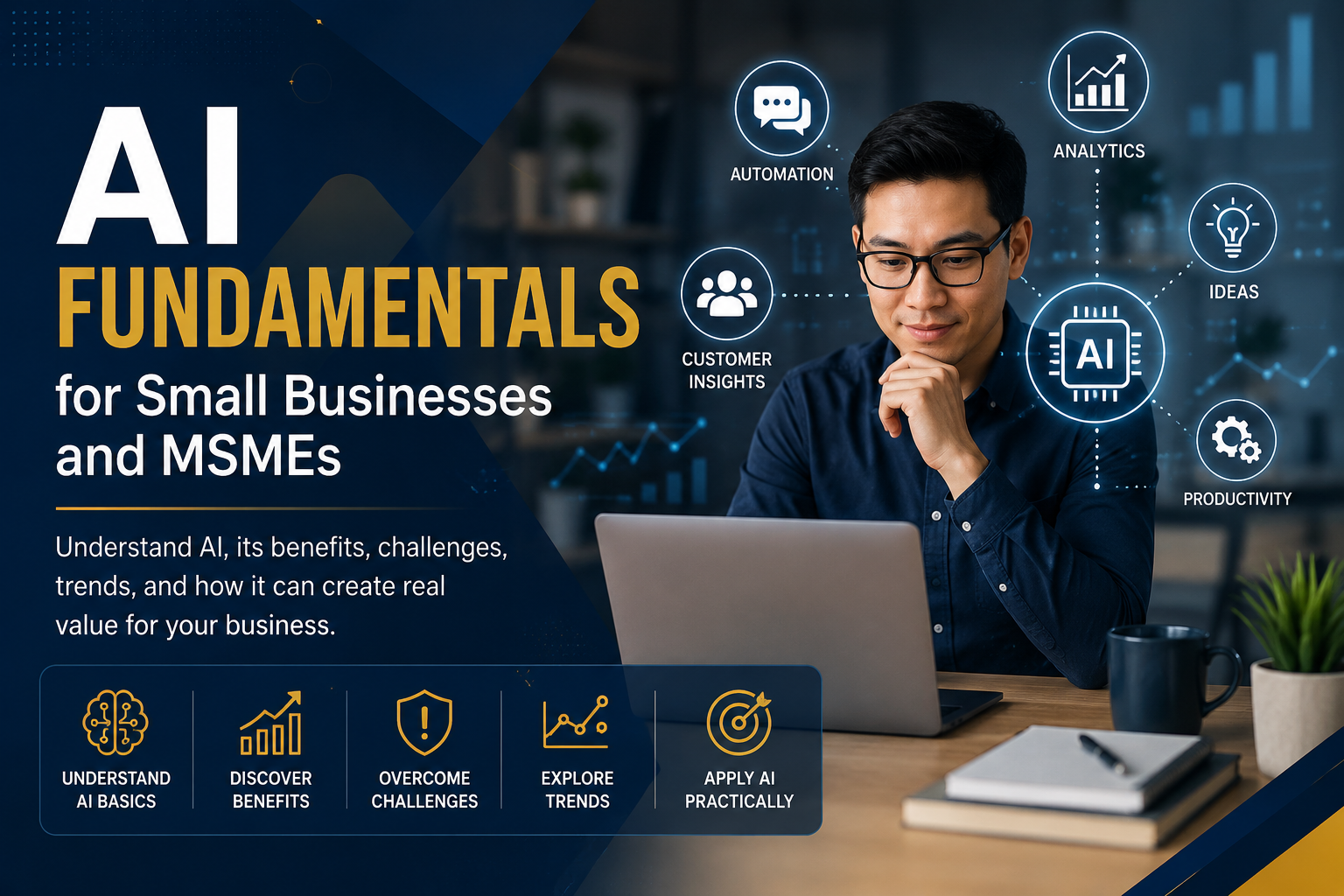
But what exactly is AI software, how does it work, and which types are actually useful for a small business? This beginner's guide explains the fundamentals in practical terms, including common examples, benefits, limitations, costs, security considerations, and how SMEs can start using AI responsibly in 2026.
What Is AI Software?
AI software is software that uses artificial intelligence techniques to perform tasks that normally require human-like abilities such as understanding language, recognizing patterns, generating content, making predictions, or supporting decisions.
Traditional software generally follows predefined instructions. For example, an accounting application may calculate a total using a formula programmed by its developers. AI software can go further by analyzing large amounts of data, identifying patterns, generating responses, or producing predictions based on models trained with data.
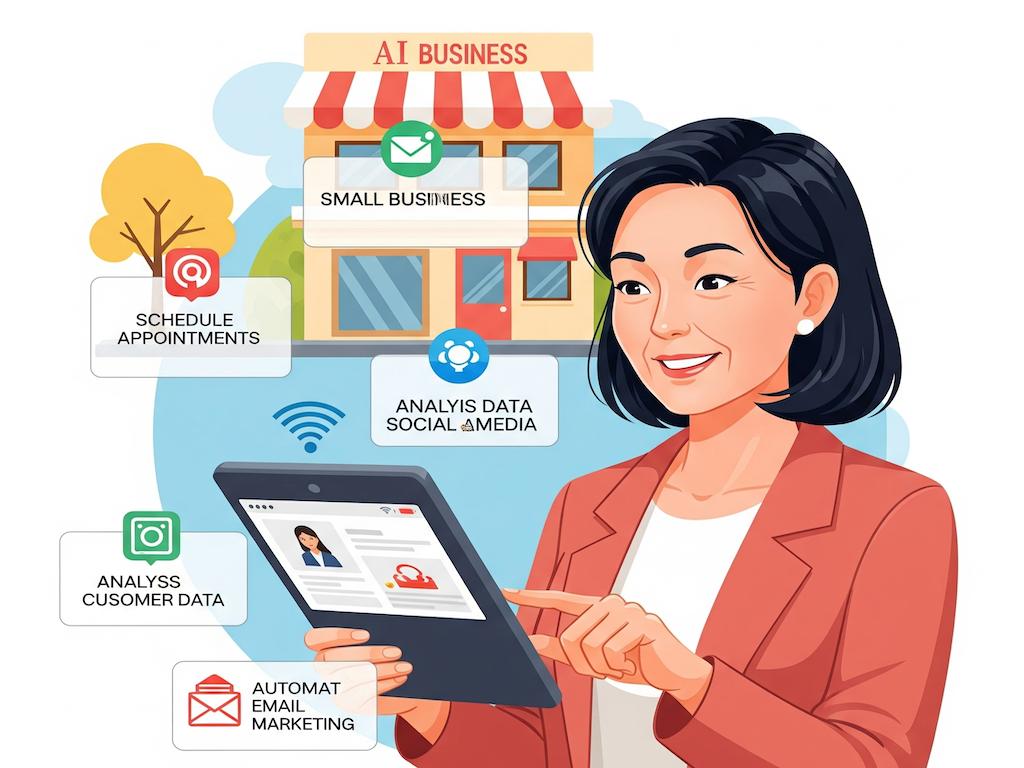
AI software can include tools for writing, customer service, sales, marketing, accounting, data analysis, cybersecurity, document processing, forecasting, and many other business activities.
For SMEs, the most important point is that AI does not necessarily mean building a sophisticated AI system from scratch. In many cases, a business can simply use an existing AI-powered application through a web browser, mobile app, business platform, or software subscription.
If you are completely new to the subject, start with what artificial intelligence means for small businesses before exploring individual AI software categories.
How Does AI Software Work?
AI software can appear complicated, but its basic business workflow is easier to understand than the technology behind it.
Most AI applications involve some combination of data, an AI model, instructions or prompts, processing, and an output that helps the user complete a task.
1. The software receives information
The first step is usually an input. This could be a customer question, spreadsheet, product description, email, image, document, sales record, or other business information.
2. An AI model processes the information
The software sends the input through an AI model designed for a particular task. Depending on the application, the model might classify information, recognize patterns, generate text, analyze an image, summarize a document, or make a prediction.
3. The AI produces an output
The result might be a written response, recommendation, summary, forecast, classification, image, report, or automated action.
4. A person reviews or uses the result
For many SME applications, the best approach is not complete automation. Instead, AI produces a useful first result while a human reviews important outputs before they are used.
This human-in-the-loop approach can be particularly important for financial decisions, legal documents, sensitive customer information, employment decisions, and other situations where mistakes can have significant consequences.
AI Software vs. Traditional Software
One of the easiest ways to understand AI software is to compare it with conventional software.
| Traditional Software | AI Software |
| Usually follows predefined rules | Can identify patterns from data |
| Often produces predictable outputs | Outputs may vary depending on inputs and models |
| Requires explicit programming for many tasks | Can perform tasks involving language, recognition, prediction, or generation |
| Often works best with structured inputs | Can work with text, images, audio, and other unstructured information |
The distinction is not always absolute. Modern business applications frequently combine traditional programming with AI capabilities. An accounting platform, for example, may use conventional calculations alongside machine learning for categorization or anomaly detection.
Common Types of AI Software for SMEs
There is no single type of AI software. Different tools are designed for different business problems. SMEs should therefore focus on the task they want to improve rather than choosing an AI tool simply because it is popular.
1. Generative AI Software
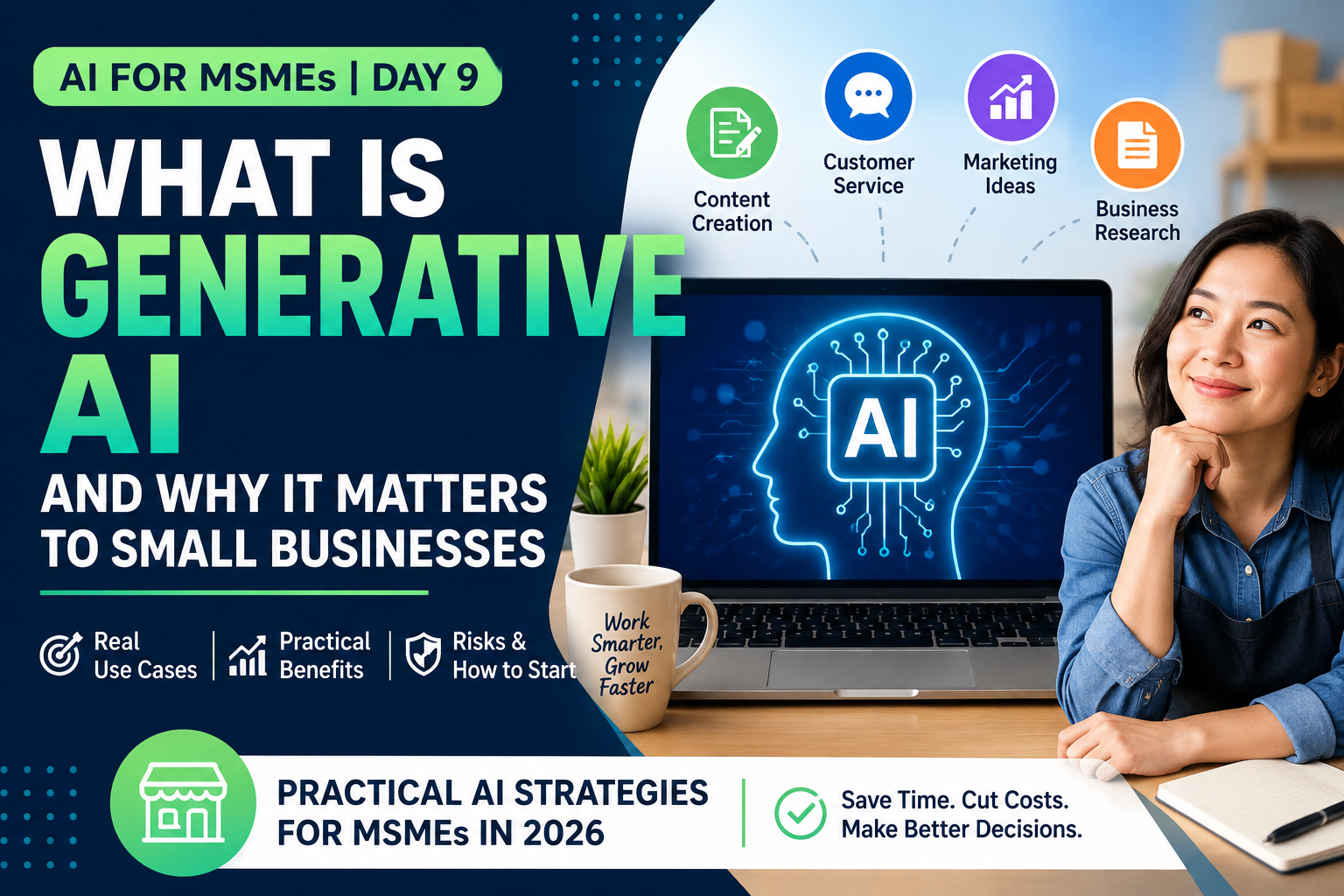
Generative AI applications create new content based on user instructions and other available information. They can generate text, ideas, summaries, images, code, and other forms of content.
An SME might use generative AI to create a first draft of a product description, brainstorm marketing ideas, summarize meeting notes, or develop frequently asked questions.
However, generated content should be reviewed for accuracy, originality, tone, and relevance before publication or customer use.
2. AI Writing and Content Tools
AI writing software can assist with emails, blog outlines, product descriptions, social media drafts, reports, and other written materials.
For a small marketing team, this can reduce the amount of time spent starting from a blank page. The strongest results usually come when employees provide specific business context and then edit the AI-generated draft.
3. AI Customer Service Software
AI-powered customer service tools can help businesses answer common questions, classify support requests, summarize conversations, and route inquiries to the appropriate employee.
Chatbots are one familiar example. Instead of requiring an employee to answer every repetitive question manually, an AI assistant can handle routine requests while more complicated issues are transferred to a human representative.
4. AI Sales and Marketing Software
AI can help sales and marketing teams analyze customer behavior, identify potential leads, personalize communications, generate campaign ideas, and predict which activities may produce better results.
For SMEs with limited marketing resources, these capabilities can make existing teams more productive without necessarily requiring additional staff.
5. AI Data Analysis Software
AI data analysis tools can help business owners explore spreadsheets, identify trends, summarize datasets, detect unusual values, and create useful insights from business information.
Instead of manually reviewing thousands of rows, an employee may be able to ask questions in natural language and receive an initial analysis.
6. AI Accounting and Finance Tools
Some accounting and financial applications use AI or machine learning to categorize transactions, detect unusual activity, automate document processing, estimate cash flow, or assist with financial reporting.
These tools can reduce administrative work, but financial outputs should still be checked by qualified personnel when accuracy and compliance are critical.
7. AI Document Processing Software
Businesses deal with invoices, contracts, forms, receipts, applications, reports, and other documents. AI document processing can extract information from these files and convert unstructured content into usable data.
This can be particularly useful for SMEs that spend significant time entering information manually.
8. AI Image and Design Software
AI-powered creative tools can assist with image generation, background removal, editing, visual concepts, and other design tasks.
Small businesses can use these tools to develop marketing assets more quickly, although they should pay attention to licensing, copyright, brand consistency, and the accuracy of generated visuals.
Why Is AI Software Important for SMEs?
Small businesses often operate with limited time, staff, and financial resources. AI software can help address some of these constraints by increasing employee productivity and reducing repetitive work.
The potential benefits include:
- Reducing repetitive administrative tasks.
- Helping employees complete certain tasks faster.
- Improving access to business information.
- Supporting customer service operations.
- Generating ideas and first drafts.
- Helping analyze business data.
- Supporting more consistent workflows.
- Allowing small teams to handle a broader range of activities.
However, AI should not be treated as an automatic solution to every business problem. Its value depends on whether it addresses a real operational need and produces enough benefit to justify its cost and implementation effort.
For a broader discussion of the advantages and business applications of AI, see our guide to the top benefits of AI for small business owners.
Real-World Examples of AI Software for Small Businesses
Consider a small online retailer with five employees.
The business receives dozens of customer messages every day, creates product descriptions, monitors sales, prepares marketing campaigns, and reviews inventory information.
Instead of attempting to automate the entire company, the owner could introduce AI gradually:
- An AI writing assistant helps prepare product-description drafts.
- An AI customer-service assistant handles frequently asked questions.
- An AI analytics feature helps summarize sales data.
- An AI document tool extracts information from supplier invoices.
- Employees review important outputs before they reach customers.
The objective is not to replace every employee. The objective is to allow employees to spend less time on repetitive activities and more time on work requiring judgment, relationships, creativity, and business expertise.
How SMEs Can Choose the Right AI Software
The number of AI products available to businesses can make selection difficult. A practical approach is to begin with the business problem rather than the technology.
Step 1: Identify a repetitive task
Look for activities that happen frequently and consume significant employee time. Examples include answering repetitive emails, summarizing documents, entering data, preparing reports, or creating routine content.
Step 2: Estimate the current cost
Calculate approximately how much employee time the task requires each week or month. This gives you a baseline against which an AI solution can be evaluated.
Step 3: Define the desired outcome
Be specific. Instead of saying, "We want AI," define the goal as "We want to reduce the time required to prepare weekly sales reports."
Step 4: Test before expanding
Start with one workflow and a small group of employees. Measure whether the software actually saves time or improves quality.
Step 5: Review security and privacy
Before uploading business information, understand how the provider handles data. Consider whether customer information, financial records, confidential documents, or intellectual property may be processed by the system.
Step 6: Measure results
Track practical metrics such as hours saved, response time, error rates, customer satisfaction, conversion rates, or operating costs.
This approach helps SMEs avoid adopting AI simply because it is fashionable. It also makes it easier to determine whether an AI investment creates measurable business value.
How Much Does AI Software Cost?
AI software can range from free tools to enterprise platforms costing significantly more. Pricing may be based on users, usage volume, features, storage, API consumption, or a monthly or annual subscription.
For an SME, the cheapest option is not necessarily the best option. A free tool may have limitations involving data privacy, usage, integrations, reliability, or administrative controls.
Likewise, an expensive enterprise platform may be unnecessary for a five-person company with a simple workflow.
A sensible starting point is to compare the expected business benefit with the total cost of ownership, including subscription fees, employee training, implementation, integrations, and ongoing management.
Is AI Software Safe for Small Businesses?
AI software can be useful, but SMEs should understand that AI introduces risks as well as opportunities.
Data privacy
Businesses should know what information they are sending to an AI service and how that information is handled. Sensitive information should not be entered into a system without understanding its privacy and security controls.
Accuracy
AI systems can generate incorrect information. A response that sounds convincing is not necessarily correct. Important business decisions should therefore include appropriate human verification.
Bias
AI systems can reflect limitations or biases present in their training data, design, or implementation. Businesses should monitor outputs when AI influences decisions involving people.
Security
Organizations should use appropriate access controls, strong authentication, employee guidelines, and vendor security reviews when adopting AI tools.
Intellectual property
Businesses should understand the terms governing generated or uploaded content, particularly when AI is used for commercial creative work.
These risks do not mean SMEs should avoid AI. They mean that AI adoption should include reasonable governance from the beginning.
Our guide to the challenges of AI adoption for small businesses provides a deeper look at these issues.
AI Software Does Not Always Mean Full Automation
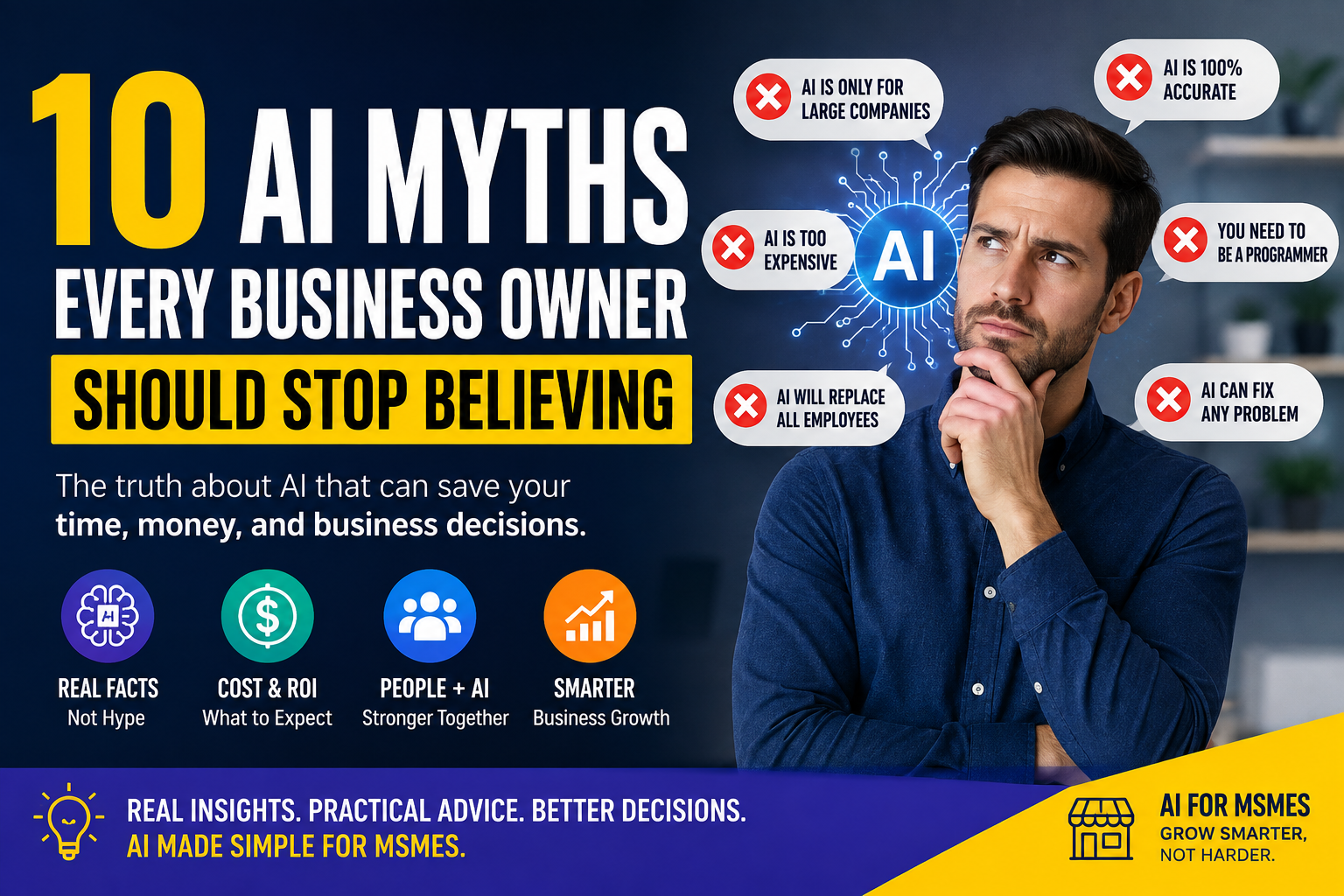
One common misconception is that adopting AI means allowing software to make decisions without human involvement.
In reality, AI can be used at different levels of automation.
- Assistance: AI helps an employee complete a task.
- Augmentation: AI performs part of a workflow while a person handles the rest.
- Automation: AI performs a defined task with limited human intervention.
- Agentic workflows: AI systems can coordinate multiple steps toward a defined objective, subject to appropriate controls.
For many SMEs, assistance and augmentation are the most practical starting points. They provide productivity benefits while keeping humans involved in important decisions.
Common Mistakes SMEs Make When Adopting AI Software
Choosing a tool before identifying a problem
Buying AI software without a clear business use case can create unnecessary costs and complexity.
Trying to automate everything at once
A large AI transformation project may be overwhelming for a small company. A focused pilot is usually easier to manage.
Ignoring employee training
Even simple AI tools require users to understand how to provide useful instructions, evaluate outputs, and recognize potential errors.
Trusting AI output blindly
AI-generated information should not automatically be treated as fact. Human review remains important, especially for high-impact work.
Ignoring data governance
Employees need clear rules about what information may be entered into AI systems and which tools are approved by the organization.
AI adoption works best when technology, people, processes, and governance are considered together.
How AI Software May Evolve in 2026 and Beyond
AI software is becoming increasingly integrated into the applications businesses already use. Instead of requiring employees to open a separate AI application, AI capabilities are increasingly appearing inside productivity, customer relationship management, accounting, marketing, analytics, and communication platforms.
Another important trend is the movement from simple content generation toward AI-assisted workflows. Rather than only answering a question, AI systems can increasingly help coordinate multiple steps within a business process.
However, increased capability also makes governance more important. As AI becomes capable of taking more actions, businesses need clear permissions, monitoring, review processes, and escalation procedures.
SMEs that build practical AI literacy now may be better positioned to evaluate these developments without adopting every new tool indiscriminately.
For a broader look at emerging developments, read our guide to the top AI trends every MSME should watch in 2026.
A Simple AI Software Adoption Framework for SMEs
A practical framework can help a small business move from curiosity to implementation.
- Discover: Identify repetitive or time-consuming workflows.
- Prioritize: Select tasks with measurable potential value.
- Evaluate: Compare AI tools based on features, price, security, integrations, and usability.
- Pilot: Test the tool on a limited workflow.
- Review: Measure accuracy, productivity, cost, and user experience.
- Govern: Establish rules for privacy, security, human review, and responsible use.
- Scale: Expand only when the pilot demonstrates measurable value.
This framework allows SMEs to treat AI as a business investment rather than simply another technology trend.
Frequently Asked Questions About AI Software
What is AI software in simple terms?
AI software is a computer application that uses artificial intelligence to perform tasks such as understanding language, recognizing patterns, generating content, analyzing information, making predictions, or assisting with decisions.
Can small businesses use AI software?
Yes. Many AI applications are available through affordable subscriptions or existing business platforms, making AI accessible to businesses without dedicated AI engineering teams.
What is the best AI software for SMEs?
There is no universally best AI software for every SME. The right choice depends on the business problem, workflow, budget, data requirements, security needs, and desired outcome.
Does AI software replace employees?
AI can automate certain tasks, but it does not automatically replace an entire job. Many SMEs use AI to assist employees, reduce repetitive work, and increase productivity while people remain responsible for judgment and important decisions.
Is AI software expensive?
AI software ranges from free services to expensive enterprise platforms. SMEs should evaluate total cost against measurable business value rather than choosing solely based on price.
Can AI software make mistakes?
Yes. AI systems can produce inaccurate, incomplete, outdated, or misleading outputs. Businesses should use appropriate human review, particularly for financial, legal, security, customer, and other high-impact information.
What should an SME automate first?
A good starting point is usually a repetitive, low-risk, measurable task such as summarizing documents, drafting routine communications, categorizing information, or preparing preliminary reports.
How should an SME start using AI?
Start with one clearly defined business problem, test an appropriate AI tool on a small scale, measure the results, establish basic governance, and expand only when the technology demonstrates practical value.
Final Takeaway
AI software is no longer exclusively a technology for large corporations. SMEs can use AI-powered applications to improve productivity, support customer service, analyze data, create content, process documents, and automate selected workflows.
The key is to approach AI strategically. Instead of asking, "Which AI tool should our business buy?", ask, "Which business problem are we trying to solve?"
That shift in perspective can help small businesses avoid unnecessary technology spending and focus on AI applications that deliver measurable value.
For a complete introduction to the subject, continue with our complete guide to AI for MSMEs, which serves as the main pillar of this AI for MSMEs content series.
As AI continues to evolve through 2026 and beyond, SMEs do not need to adopt every new technology immediately. They need to understand the fundamentals, identify useful opportunities, protect their data, train their people, and implement AI where it genuinely improves the business.