Creating an AI Adoption Roadmap | Plan and Scale AI for Small Businesses | Beritaja
 By: Albert Michael - Sunday, 06 September 2026 21:53:46 • 22 min read

Creating an AI Adoption Roadmap means building a practical sequence for deciding where artificial intelligence can help a business, which use cases should come first, how they should be tested, what risks need to be controlled, and when an AI initiative is ready to expand.
An AI adoption roadmap is useful because adopting AI is not simply a matter of buying software. Small businesses need to decide which problems are worth solving, what data and employees are involved, how success will be measured, and whether the expected benefits justify the cost and risk.
This guide explains how small businesses, MSMEs, SMEs, entrepreneurs, managers, and non-technical professionals can create an AI adoption roadmap from the first opportunity assessment through testing, measurement, governance, and gradual expansion.
What Is an AI Adoption Roadmap?
An AI adoption roadmap is a structured plan that shows how a business will identify, prioritize, test, implement, govern, and scale artificial intelligence use cases over time. Instead of attempting to introduce AI across the entire organization simultaneously, the roadmap creates a sequence of manageable steps.
A useful roadmap connects three elements:
- Business objectives: What does the company want to improve?
- AI opportunities: Where can AI realistically contribute?
- Implementation requirements: What people, data, technology, controls, and measurement are required?
The roadmap should therefore be treated as a business planning tool rather than a list of AI products. The technology can change over time, while the underlying business objectives and decision criteria remain more stable.
AI Adoption Roadmap vs. AI Strategy
An AI strategy explains why and where a business intends to use artificial intelligence, while an AI adoption roadmap explains how that strategy will be implemented over time. The two should work together rather than being treated as separate projects.
| AI Strategy | AI Adoption Roadmap |
| Defines business objectives | Sequences implementation activities |
| Identifies strategic AI opportunities | Prioritizes specific use cases |
| Defines governance principles | Establishes practical controls |
| Defines desired outcomes | Defines milestones and measurements |
| Provides long-term direction | Provides an implementation path |
If your business has not yet established its broader direction, start with a practical AI strategy for your business before creating a detailed adoption roadmap.
Why Small Businesses Need an AI Adoption Roadmap
Small businesses often have limited budgets, employees, technical resources, and time. An adoption roadmap helps prevent those resources from being spread across too many AI initiatives at once.
Without a roadmap, a business may purchase several AI tools, experiment with unrelated workflows, or automate processes without establishing whether the changes actually improve business performance.
A roadmap creates a more disciplined approach by answering questions such as:
- Which AI opportunity should we address first?
- Is the problem significant enough to justify an AI project?
- Do we have the necessary data?
- Who will own the project?
- What risks need to be controlled?
- How will we measure success?
- When should we stop, continue, or scale the project?
This is particularly important when AI adoption begins to move from individual employee experimentation into formal business processes.
What Should an AI Adoption Roadmap Include?
A practical AI adoption roadmap should include business priorities, candidate use cases, data requirements, technology choices, ownership, risk controls, pilot projects, success metrics, and a plan for scaling. It should also identify situations where the business should not use AI.
A simple roadmap can be organized into these stages:
- Assess business readiness
- Identify business problems
- Map potential AI use cases
- Prioritize opportunities
- Evaluate data and technology requirements
- Establish governance and risk controls
- Run a small pilot
- Measure results
- Improve the workflow
- Scale successful use cases
Step-by-Step: Creating an AI Adoption Roadmap
Step 1: Assess Your Current Business Readiness
Before selecting an AI project, determine whether the business has enough operational structure to adopt it successfully. AI readiness is not only about technical infrastructure. It also involves employees, processes, data, leadership support, and the ability to evaluate results.
Consider the following areas:
- availability and quality of business data;
- existing software and systems;
- employee familiarity with digital tools;
- management support;
- data privacy practices;
- security controls;
- available budget;
- ability to measure business outcomes.
A business with limited digital processes may need to improve basic data organization before introducing sophisticated AI. For example, a retailer with inconsistent product records may gain more value from cleaning its inventory data than from immediately deploying predictive analytics.
Step 2: Identify Real Business Problems
The next step is to identify problems that are important enough to justify attention. Do not begin by asking which AI tools are popular. Begin by asking which business processes consume excessive time, create repeated errors, require large amounts of information processing, or limit the organization's ability to serve customers.
Potential candidates include:
- repetitive customer inquiries;
- manual document summarization;
- repetitive administrative tasks;
- large volumes of customer feedback;
- sales data that is difficult to analyze;
- time-consuming content preparation;
- repetitive internal reporting;
- routine data classification.
Not every inefficient process is an AI problem. Sometimes a better process, spreadsheet, database, conventional software feature, or employee training can solve the issue more simply.
Step 3: Map the Existing Workflow
Document how the process currently works before introducing AI. This gives the business a baseline for comparison and makes it easier to identify where AI could actually provide value.
Document:
- what starts the process;
- what information enters the workflow;
- which employees perform each step;
- which software systems are involved;
- where delays occur;
- where errors occur;
- what output is produced;
- how long the process normally takes.
This step is important because automating a poorly designed process can simply make a bad workflow faster. In some cases, process simplification should happen before AI adoption.
Step 4: Identify Potential AI Use Cases
Once the workflow is understood, identify specific points where artificial intelligence may help.
| Business Problem | Possible AI Application | Example |
| Large amounts of text | Generative AI or large language models | Summarizing documents |
| Repeated customer questions | AI-assisted customer service | Classifying and drafting responses |
| Large business datasets | AI analytics or machine learning | Identifying sales patterns |
| Repetitive workflows | AI automation | Routing routine requests |
| Complex business information | AI-assisted decision support | Comparing performance indicators |
The objective is not to maximize the number of AI use cases. It is to identify a small number of opportunities where AI has a plausible connection to a meaningful business outcome.
Step 5: Prioritize AI Use Cases
After identifying potential opportunities, rank them. Small businesses should generally begin with use cases that have meaningful potential value while remaining manageable in terms of cost, complexity, risk, and data requirements.
Useful evaluation criteria include:
- Business impact: How important is the problem?
- Implementation effort: How difficult is the project?
- Data readiness: Is suitable information available?
- Cost: What software, integration, training, or infrastructure is required?
- Risk: What could go wrong?
- Employee adoption: Will people actually use the solution?
- Measurability: Can improvement be demonstrated?
A simple scoring system can help management compare opportunities consistently. The exact scoring method matters less than using clear criteria before committing resources.
Step 6: Choose the Appropriate AI Approach
Different business problems require different technologies. A roadmap should distinguish between generative AI, machine learning, large language models, AI analytics, business intelligence, and workflow automation rather than treating all of them as interchangeable.
For example, a professional-services company that needs meeting summaries may benefit from a language-based AI application, while a retailer trying to understand demand patterns may require analytical or machine-learning capabilities.
The simplest suitable technology is often preferable to an unnecessarily complex system. A business should choose technology according to the problem, data, workflow, budget, and required level of accuracy.
Step 7: Establish AI Governance Before Scaling
Governance defines how AI should be used responsibly inside the organization. It becomes increasingly important when AI handles customer information, financial records, confidential documents, employee information, or decisions with significant consequences.
A basic governance framework can define:
- which AI applications are approved;
- what information employees may submit to AI systems;
- which information is restricted;
- when human review is mandatory;
- who owns each AI workflow;
- how AI outputs should be checked;
- how incidents should be reported;
- how AI systems should be reviewed over time.
Businesses developing this part of their roadmap can also explore the AI governance and strategy guide for small businesses for broader guidance on responsible AI adoption.
Step 8: Review Data Privacy and Security
Data should be treated as a core part of the adoption roadmap. Before connecting an AI system to business information, determine what data is involved, who can access it, how it is transferred, and what security and privacy controls apply.
Particular attention may be required when workflows involve customer records, financial information, employee information, confidential business documents, proprietary material, or other sensitive data.
The roadmap should therefore include a data review before a pilot moves into production. If the business cannot adequately protect the information involved, the use case may need to be redesigned or rejected.
Step 9: Select a Small Pilot
A pilot is a controlled test of an AI use case before broader deployment. It should be small enough to manage but realistic enough to produce useful evidence.
For example:
- A retailer could test AI-assisted product descriptions for a limited product category.
- A restaurant could test AI-assisted classification of customer feedback.
- An agency could test AI-assisted meeting summaries with one internal team.
- An e-commerce business could test automated classification of routine customer inquiries.
A pilot should have a defined scope, responsible owner, success criteria, review process, and time period appropriate to the workflow.
Step 10: Establish a Baseline Before Testing
Measurement is much easier when the business knows how the process worked before AI was introduced. Record relevant baseline information such as processing time, number of tasks completed, error rates, correction requirements, operating costs, or employee workload.
The appropriate metric depends on the use case. A customer-service workflow might focus on response time and quality, while a document workflow might focus on preparation time and correction rates.
Avoid measuring metrics simply because they are easy to collect. The measurement should reflect the original business objective.
Step 11: Test AI Output and Human Review
During the pilot, evaluate not only whether AI produces an output but whether the output is accurate and useful enough for the intended workflow.
Review questions can include:
- Is the output factually correct?
- How often does an employee need to correct it?
- Does AI introduce new errors?
- Does the workflow actually save time?
- Does the output meet the required quality standard?
- Are there privacy or security concerns?
- Do employees understand when they need to intervene?
Human oversight is especially important during early adoption because employees can identify problems that may not be obvious from automated performance measurements.
Step 12: Measure Business Outcomes
The next stage is to determine whether the AI project created meaningful business value. A successful AI experiment is not necessarily one that produces technically impressive output. It is one that improves a relevant business outcome without introducing unacceptable costs or risks.
Depending on the use case, useful measurements may include:
- time saved;
- processing speed;
- error rates;
- correction workload;
- employee adoption;
- customer experience;
- operating costs;
- revenue-related outcomes;
- profitability;
- overall business value.
When an AI initiative is expected to affect sales, costs, or other financial outcomes, businesses can use a Revenue Calculator to explore different revenue scenarios and a Profit Margin Calculator to examine whether changes in revenue and costs translate into stronger profitability.
Some benefits are difficult to express directly in financial terms. For example, reducing administrative workload may allow employees to focus on customer relationships or higher-value work. The roadmap should recognize these benefits while still using measurable evidence wherever possible.
When the project involves a significant financial investment, an ROI Calculator can also help compare the expected return with the resources invested in the AI initiative.
Step 13: Decide Whether to Stop, Improve, or Scale
Every pilot should lead to a decision. There are three common outcomes: stop the project, improve and retest it, or expand it.
| Result | Possible Action |
| Low value and high risk | Stop or redesign the project |
| Promising but inconsistent | Improve the workflow and test again |
| Useful but limited | Expand selectively |
| Strong value with manageable risk | Scale gradually |
For AI projects that require meaningful upfront investment, businesses can also use a Break-Even Point Calculator to estimate the level of additional sales or revenue needed to recover the investment.
This decision point prevents a common mistake: continuing an AI project simply because the organization has already invested time or money in it.
Step 14: Scale Gradually
Successful pilots should normally be expanded in stages rather than deployed everywhere immediately. Scaling may involve additional employees, departments, data sources, workflows, or software integrations.
A gradual expansion process can include:
- documenting the successful workflow;
- creating usage guidelines;
- training additional employees;
- strengthening security and access controls;
- integrating the workflow with existing systems;
- monitoring output quality;
- reviewing costs and business outcomes;
- periodically reassessing whether the system remains appropriate.
Scaling should not mean removing human oversight automatically. The level of review should remain appropriate to the consequences of the AI-assisted process.
AI Adoption Roadmap Example
Consider a hypothetical small e-commerce business that receives hundreds of customer questions about products, delivery, returns, and order information.
The business could create a roadmap such as:
| Roadmap Stage | Example Action |
| Identify problem | Employees spend significant time handling repetitive questions |
| Define outcome | Reduce repetitive workload while maintaining response quality |
| Map workflow | Analyze how inquiries are received, classified, answered, and escalated |
| Select AI use case | Classify routine inquiries and draft responses |
| Governance | Require human review for sensitive or unusual cases |
| Pilot | Test the workflow on a limited category of routine questions |
| Measurement | Compare response time, correction rate, and employee workload |
| Scale | Expand only if quality and business outcomes remain acceptable |
This example illustrates why an adoption roadmap should focus on the entire workflow rather than simply deploying an AI chatbot or automation tool.
AI Adoption Roadmap Examples by Business Type
Retail Business
Problem: Employees spend substantial time preparing and updating product information.
How AI is used: Generative AI can assist with initial product-description drafts and categorization.
Expected benefit: Reduced repetitive writing and more consistent initial drafts.
Human oversight required: Employees should verify specifications, pricing, claims, measurements, and other product details.
Restaurant
Problem: Management receives customer feedback through multiple channels and struggles to identify recurring themes.
How AI is used: AI can help classify feedback and summarize recurring topics.
Expected benefit: Faster identification of issues that may require management attention.
Human oversight required: Managers should interpret the feedback and consider operational context before making changes.
Professional Services
Problem: Employees spend considerable time organizing meeting notes and documents.
How AI is used: An AI assistant can help produce draft summaries and organize information.
Expected benefit: Less administrative effort.
Human oversight required: Important facts, commitments, deadlines, and client information should be checked against original sources.
Manufacturing Business
Problem: Managers need better visibility into operational patterns and potential process issues.
How AI is used: Analytical or machine-learning systems may help identify unusual patterns in appropriate operational data.
Expected benefit: Earlier identification of patterns that deserve investigation.
Human oversight required: Operational staff should validate findings before maintenance, production, or safety decisions are made.
Marketing Agency
Problem: Teams spend time researching topics, organizing information, and preparing initial content drafts.
How AI is used: Generative AI can assist with research organization, brainstorming, and first drafts.
Expected benefit: Faster preparation of preliminary work.
Human oversight required: Staff should verify facts, originality, client requirements, brand guidelines, and final recommendations.
How to Prioritize AI Projects
The strongest AI adoption roadmaps do not necessarily begin with the most technically advanced project. They often begin with a problem that is important, understandable, measurable, and relatively manageable.
A practical prioritization model can consider four dimensions:
- Value: How much could solving the problem help the business?
- Feasibility: Can the business realistically implement the solution?
- Risk: What are the consequences if the system performs poorly?
- Readiness: Are the necessary people, data, processes, and systems available?
A high-value, low-risk workflow with accessible data can be a better starting point than an ambitious AI project requiring complex integrations and specialized expertise.
Common AI Adoption Roadmap Mistakes
Choosing AI Tools Before Identifying the Problem
Starting with a product can cause businesses to search for problems that fit the technology. A stronger roadmap starts with business needs and evaluates technology afterward.
Trying to Implement Too Many Projects
Running numerous AI projects simultaneously can overwhelm employees and make it difficult to determine which initiatives create genuine value.
Ignoring Data Quality
AI systems depend on the quality and relevance of the information provided to them. Inconsistent, incomplete, outdated, or poorly structured data can undermine an otherwise promising project.
Measuring Activity Instead of Outcomes
Counting how many employees use an AI tool does not necessarily demonstrate business value. Adoption is useful to monitor, but it should be connected to meaningful outcomes such as time saved, quality, cost, customer experience, or another relevant objective.
Removing Human Review Too Quickly
AI-generated output can be incorrect or incomplete. Removing review before the workflow has demonstrated reliable performance can introduce unnecessary risk.
Ignoring Employee Feedback
Employees often understand the practical details of a workflow better than managers or technology vendors. Their feedback can reveal whether AI actually reduces workload or simply moves work into a different part of the process.
Scaling Before the Pilot Is Understood
A successful demonstration does not automatically prove that an AI system is ready for organization-wide deployment. Scaling can introduce new data, users, integrations, costs, and risks that were not visible during the pilot.
Risks and Limitations of AI Adoption
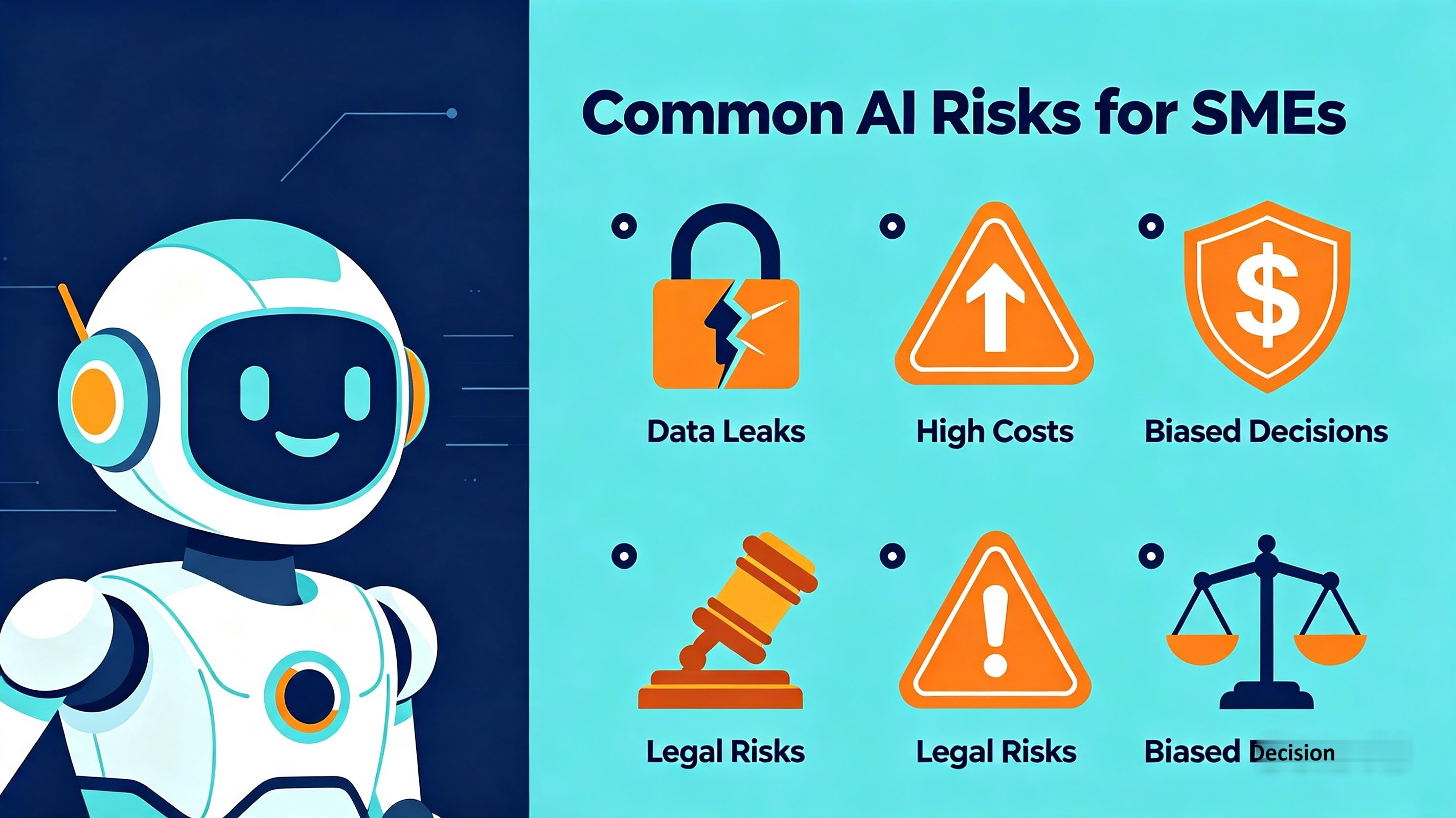
An AI adoption roadmap should include risk management from the beginning. Artificial intelligence can provide useful capabilities, but implementation can also create operational, financial, privacy, security, and governance challenges.
- Incorrect outputs: AI systems can generate inaccurate information or recommendations.
- Data quality problems: Poor source data can lead to unreliable analysis.
- Privacy concerns: Business and customer information may require careful handling.
- Security risks: New integrations and data flows can create additional systems that need protection.
- Bias: Data and system design can contribute to unfair or distorted results.
- Cost: Software, integration, training, data preparation, and ongoing management can increase total project costs.
- Integration complexity: Connecting AI with existing systems may be more difficult than expected.
- Employee resistance: Poor communication or inadequate training can reduce adoption.
- Over-reliance: Employees may give excessive authority to AI-generated recommendations.
A responsible roadmap therefore asks not only whether AI can work, but whether the business can operate the system safely and sustainably.
When a Business Should Not Adopt AI
AI is not automatically the best solution. A business should consider alternatives when a conventional approach is cheaper, simpler, more reliable, or easier to control.
AI may be unnecessary when:
- the task is already handled efficiently;
- a simple spreadsheet or conventional software solves the problem;
- the available data is inadequate;
- the business cannot review the output appropriately;
- implementation costs exceed the expected benefit;
- the risks are disproportionate to the potential value;
- employees would spend more time correcting AI output than performing the original task.
The ability to reject an AI project is an important part of a mature adoption roadmap. The objective is not maximum AI usage. The objective is better business performance.
How AI Adoption Matures Over Time
AI adoption can become progressively more structured as a business gains experience. A company does not need to begin with a highly sophisticated enterprise AI program.
| Stage | Typical Focus |
| Exploration | Learning about AI and identifying possible use cases |
| Experimentation | Testing small, low-risk workflows |
| Pilot | Measuring a defined business use case |
| Operational adoption | Integrating successful workflows into normal processes |
| Governance | Establishing policies, controls, ownership, and monitoring |
| Scaling | Expanding proven use cases where business value remains strong |
These stages are not necessarily linear. A business may return to experimentation when a new technology appears or stop a mature workflow if its value declines.
Best Practices for Creating an AI Adoption Roadmap
- Start with business objectives: Define what the organization wants to improve before selecting technology.
- Prioritize focused use cases: Begin with manageable opportunities rather than attempting to transform everything simultaneously.
- Build around existing workflows: Understand how employees currently work before changing the process.
- Use measurable objectives: Define how success will be evaluated before starting a pilot.
- Include governance early: Privacy, security, human oversight, and accountability should not be added only after problems occur.
- Involve employees: Include the people who will actually use the AI system in planning and evaluation.
- Prefer simplicity: Use the simplest technology that reliably solves the problem.
- Scale gradually: Expand only when evidence supports the additional investment and risk.
- Review the roadmap regularly: Business conditions, technology capabilities, regulations, and organizational priorities can change.
A Simple AI Adoption Roadmap for Small Businesses
For a small business that wants a straightforward starting point, the following framework can be used as a practical roadmap:
- Identify one meaningful problem. Choose a repetitive, data-heavy, information-intensive, or time-consuming process.
- Define the desired outcome. Decide what improvement would make the project worthwhile.
- Document the existing workflow. Understand the people, systems, information, delays, and outputs involved.
- Identify where AI could help. Determine whether AI can improve a specific step rather than replacing the entire process unnecessarily.
- Assess feasibility and risk. Review data, cost, privacy, security, employee readiness, and technical requirements.
- Choose a small pilot. Test the idea within a controlled scope.
- Establish human oversight. Define when employees must review, approve, correct, or reject AI output.
- Measure the results. Compare performance against the baseline and the original business objective.
- Improve or stop. Fix weaknesses or discontinue the project when the evidence does not justify continuation.
- Scale selectively. Expand successful workflows while continuing to monitor performance, costs, and risks.
This approach gives a small business a repeatable process for moving from AI experimentation toward responsible adoption.
Frequently Asked Questions About Creating an AI Adoption Roadmap
What is the first step in creating an AI adoption roadmap?
The first step is to identify a meaningful business problem rather than selecting an AI tool. Look for a workflow that is repetitive, time-consuming, data-heavy, or difficult to manage. Then define the business outcome you want to improve. This creates a clearer basis for deciding whether AI is actually appropriate.
How is an AI adoption roadmap different from an AI strategy?
An AI strategy defines the broader business objectives, priorities, opportunities, and principles for using artificial intelligence. An AI adoption roadmap turns those priorities into an implementation sequence, including use-case selection, pilots, governance, measurement, and scaling. The strategy provides direction, while the roadmap provides a practical path for execution.
How many AI projects should a small business start with?
There is no universal number, but small businesses generally benefit from keeping the initial scope manageable. One well-defined pilot can provide more useful learning than several unrelated projects running simultaneously. The appropriate number depends on available employees, budget, data, technical capability, and the complexity of each project.
What should a business consider before adopting AI?
Businesses should consider the business problem, expected value, data quality, privacy, security, implementation cost, employee readiness, workflow compatibility, human oversight, and measurement. It is also important to consider whether a conventional software solution could solve the problem more simply. AI should be selected because it provides a useful advantage, not simply because it is available.
Should AI adoption begin with automation?
Automation can be a useful starting point when a workflow contains repetitive and predictable tasks, but it is not automatically the best first project. Businesses should first understand the process and determine whether automation addresses a meaningful problem. In some cases, analytics, generative AI, business intelligence, or employee productivity support may be more appropriate.
How should an AI pilot be measured?
Measure the outcome connected to the original business objective. Depending on the use case, this could include processing time, error rates, correction workload, operating cost, employee adoption, customer experience, or another relevant business metric. Establishing a baseline before the pilot makes it easier to determine whether the AI-assisted workflow actually improved performance.
When should a business scale an AI project?
A business should consider scaling when the pilot demonstrates meaningful value, the workflow is sufficiently reliable, risks are manageable, employees understand how to use it, and the additional cost is justified. Scaling should be gradual because expanding users, data, and integrations can introduce problems that were not visible during a small pilot.
Can a small business create an AI adoption roadmap without technical employees?
Yes. A small business does not necessarily need a dedicated AI engineering team to create its initial roadmap. Business owners and employees can begin by documenting problems, workflows, desired outcomes, data requirements, risks, and success measures. Technical expertise may become necessary for more complex integrations or custom systems, but business understanding remains essential throughout the process.
Conclusion: Creating an AI Adoption Roadmap Around Business Value
Creating an AI Adoption Roadmap is fundamentally about turning AI interest into a controlled, measurable business process. Start with a real problem, define the desired outcome, understand the existing workflow, identify an appropriate AI opportunity, assess risks, test a small pilot, measure the results, and scale only when the evidence supports expansion.
For small businesses, the strongest roadmap is rarely the one containing the largest number of AI tools. It is the roadmap that connects technology to meaningful business objectives while protecting data, involving employees, maintaining human oversight, and controlling unnecessary cost and complexity.
AI adoption should also remain flexible. Technologies, business priorities, employee capabilities, and regulatory requirements can change, so the roadmap should be reviewed and updated rather than treated as a permanent checklist.
A practical next step is to choose one repetitive, information-heavy, or data-driven process in your business. Document how it works today, identify the outcome you want to improve, and evaluate whether AI can provide a measurable advantage without creating unacceptable risk.
For broader guidance on artificial intelligence for small businesses, explore the AI for MSMEs topical hub, which connects foundational AI concepts with practical topics such as automation, productivity, decision-making, business intelligence, governance, privacy, risk management, and AI strategy.